


5 Days a week from 8:30 am to 5:30 pm

How to Read Commercial Grease Filter Dimensions Before Ordering a Replacement
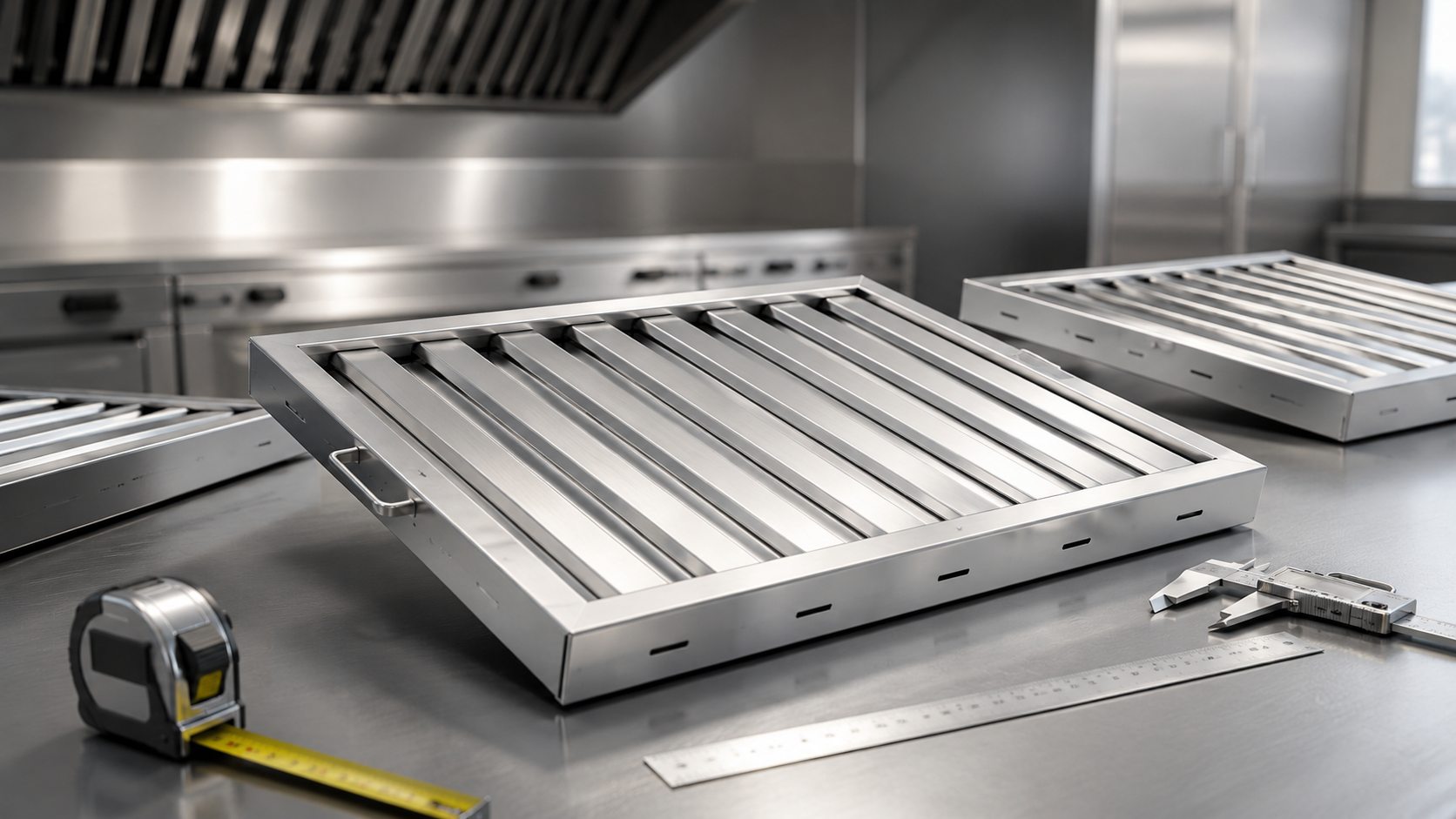
Ordering a replacement grease filter should begin with a measurement sheet, not with a photograph or an old invoice. For commercial kitchen contractors, hood manufacturers, restaurant maintenance teams, and replacement-parts buyers, the important dimensions are the installed width, height, depth, frame profile, handle position, and the way the filter engages with the hood track. A filter that is only slightly different from the original can still leave a bypass gap, sit loosely in its retaining channel, or become difficult to remove for cleaning. Before ordering a replacement hood filter, measure both the old filter and the hood opening and label every dimension according to its installed orientation.
Which Grease Filter Dimensions Should Buyers Measure First?
The three figures most buyers see are width, height, and depth. The problem is that a sequence such as 500 × 400 × 40 mm does not explain which side is horizontal when the filter is installed. Different drawings and supplier catalogs may use different orientation conventions, so the safest RFQ states the dimensions clearly—for example, “500 mm installed width × 400 mm installed height × 40 mm frame depth.”
Measurements should be taken from the rigid outside frame rather than from internal baffles or mesh. If the old filter is bent, check the dimension at more than one point before using it as a master reference. It is also useful to place the filter on a flat surface and check whether the frame is still square.
What Should Appear on the Measurement Sheet?
A replacement drawing should contain more than three numbers.
| Measurement | Where to measure | Why it matters |
|---|---|---|
| Installed width | Outer side edge to outer side edge | Controls side-to-side fit |
| Installed height | Bottom outer edge to top outer edge | Controls track engagement |
| Frame depth | Front face to rear face | Affects retaining-channel clearance |
| Handle position | From a fixed frame edge | Affects installation and removal |
| Frame profile | Lips, flanges, recesses, formed edges | May affect how the filter sits |
| Orientation | Mark top/bottom and front/rear | Prevents dimensional confusion |
Units should be written directly on the drawing. When a buyer, distributor, and manufacturer work in different markets, “500” without “mm” or “in.” creates unnecessary risk.
Should You Measure the Existing Filter or the Hood Opening?
Both should be measured because they answer different questions. The old filter shows what is currently installed; the hood opening shows what the replacement actually needs to fit. These two references do not always agree. Older kitchens may have been using an approximate replacement for years, or the existing frame may have become bent through repeated removal and cleaning.
Begin by measuring one filter that is still in reasonable condition. Then measure the upper and lower retaining channels inside the hood. Many commercial filters are installed by lifting the upper edge into a top channel before lowering the bottom edge into position. This means the available installation movement matters just as much as the final opening dimension.
Why Does Filter-Bank Width Matter?
When several filters are installed side by side, measure the entire filter bank rather than only one opening. Small dimensional differences that seem insignificant on a single filter can become obvious across four or six units. If every replacement is slightly narrower than the original, the accumulated gap may become large enough to change how air passes through the bank.
Physical fit also has to be considered alongside ventilation behavior. Filter structure, condition, and installation all influence grease filter airflow, so dimensional compatibility should not be treated as the only performance criterion.
Which Details Can Make a Correctly Sized Filter Still Not Fit?
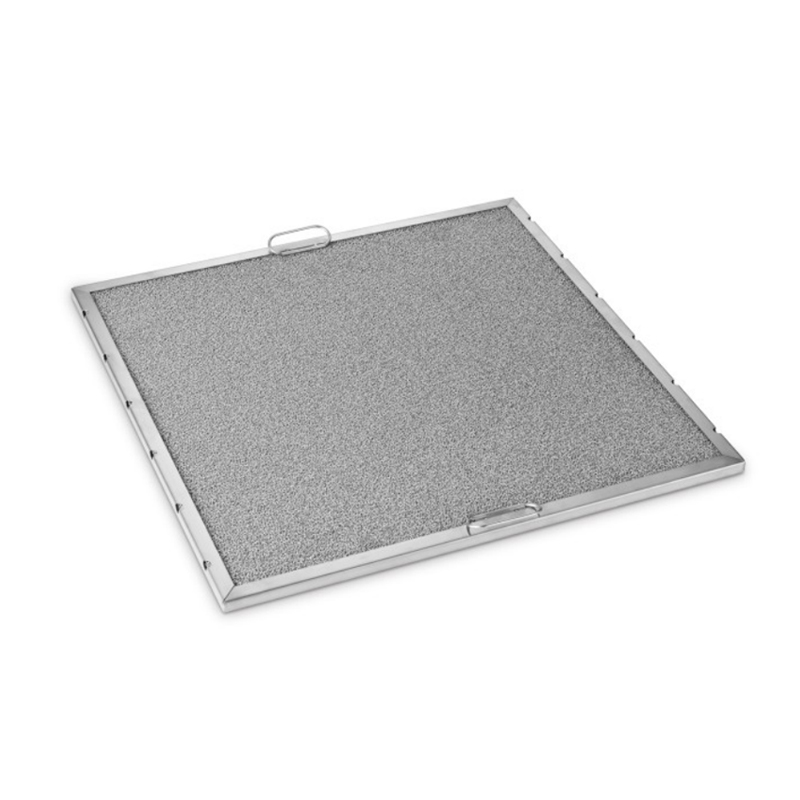
Width, height, and depth do not describe every point where a filter interacts with the hood. A replacement can have the same nominal dimensions as the old part yet use a different frame profile that prevents it from engaging correctly with the retaining channel.
Frame Geometry and Retaining Features
Inspect the filter from the side. Record any formed lip, flange, recessed edge, drain feature, or unusual frame profile. On some installations, these features contribute directly to how the filter is located and retained. They should therefore appear on the drawing rather than being left for the supplier to infer from a photograph.
Handle Position and Installation Direction
The handle must remain accessible once neighboring filters are fitted. Record which face it is on and its position relative to a fixed edge. Installation direction should also be marked. Baffle filters may use an internal arrangement intended to support grease drainage and controlled airflow, so a buyer should not assume that a rectangular filter can always be rotated freely.
Adjacent Filter Compatibility
A replacement should be checked with the remaining filters installed beside it. A single sample can appear correct in an empty opening but create an unexpected gap or overlap when the full bank is assembled. This is particularly important when only part of an existing filter bank is being replaced.
Buyers comparing different constructions can review the broader commercial grease filter range before preparing the RFQ, but dimensional similarity should never be taken as proof of interchangeability.
How Should Buyers Prepare a Replacement Grease Filter RFQ?
A good RFQ should allow a supplier who has never visited the kitchen to understand the installation. A dimensioned sketch is usually more valuable than several photographs with no scale. The sketch should show installed width, height, depth, frame profile, handle position, and installation direction. If the filter is fitted at an angle, include that information as well.
The buyer should also state how many filters are installed in one hood, whether the requirement is for a one-time replacement or a repeat spare-parts program, and whether all units in the filter bank are being replaced together. Photographs should include the existing filter from the front and side, the empty retaining track, and the complete filter bank where practical.
What Information Should Go to the Supplier?
A practical RFQ should include:
-
Outer filter dimensions
-
Hood-opening dimensions
-
Upper and lower track measurements
-
Frame profile
-
Handle position
-
Installation orientation
-
Number of filters in one hood
-
Material requirement
-
Existing model or part number, if known
-
Required quantity
-
Photographs
-
Drawing or reference sample
Do not use “same as sample” as the only specification. Samples can be distorted or lost, while a controlled dimensional drawing remains useful for repeat purchasing.
What Should Buyers Check Before Approving a Replacement Sample?
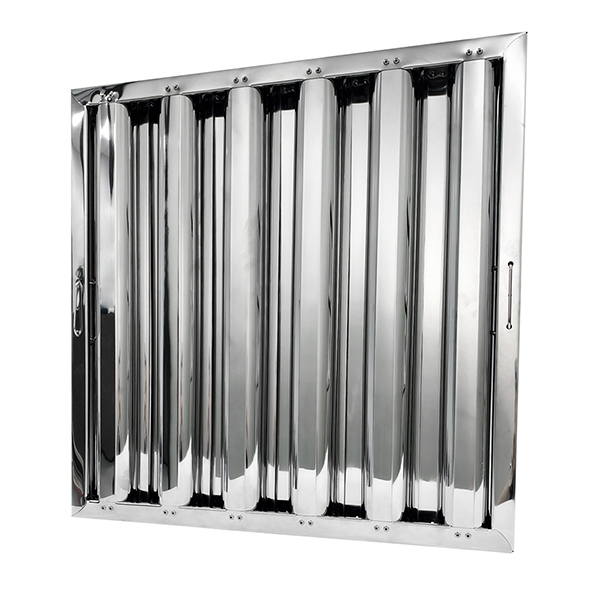
For a non-standard filter or a larger order, one sample should be installed in the actual hood before the full quantity is approved. The test should be carried out while the equipment is safely shut down according to the site’s maintenance procedure.
The sample should enter and leave the retaining channels without being forced, bent, or twisted. Once installed, it should sit securely, remain aligned with neighboring filters, and leave no unusual gaps around the frame. Removal is just as important as installation because commercial grease filters need regular cleaning.
Sample Approval Checklist
-
Outer dimensions match the approved drawing.
-
The filter enters the hood without forcing.
-
Upper and lower tracks engage correctly.
-
Frame sits squarely after installation.
-
Handle remains accessible.
-
Installation direction is correct.
-
Adjacent filters fit correctly.
-
No unusual bypass gaps are visible.
-
Filter can be removed easily for cleaning.
-
Material and construction match the RFQ.
If the sample fails one of these checks, revise the drawing before approving production rather than asking installers to compensate during installation.
How Does Foshan Simple Technology Co., Ltd. Support Grease Filter Sourcing?
Foshan Simple Technology Co., Ltd. supplies commercial kitchen components for OEM, distribution, and replacement-parts applications, including grease filters, fryer baskets, adjustable legs, bullet feet, and range hood lights. Buyers sourcing grease-filter replacements can review the company’s commercial grease filter products, including specific stainless steel grease-filter models where a product-level specification is required. For non-standard orders, providing drawings, existing samples, hood measurements, installation photographs, material requirements, and order quantities gives both buyer and supplier a clearer basis for confirming compatibility before production.
Conclusion
A replacement commercial grease filter should be ordered from a documented installation rather than from appearance alone. Measure the old filter and the hood, label width, height, and depth clearly, and record the retaining tracks, frame profile, handle position, and installation direction. The next step is to send the supplier a dimensioned drawing with photographs and request written confirmation of the specification. For custom dimensions or volume orders, approve one sample in the actual hood before releasing production.
FAQs
1. What measurements do I need for a replacement grease filter?
Record installed width, height, frame depth, handle position, frame profile, and installation orientation. Measuring the hood opening and retaining channels provides an additional compatibility check.
2. Are grease filter dimensions always written as width × height × depth?
No convention should be assumed. Label each dimension individually on the RFQ or drawing so the supplier knows exactly how the filter is oriented when installed.
3. Should a replacement grease filter fit tightly in the hood?
It should remain securely seated without excessive gaps while still allowing enough clearance for installation and cleaning. The retaining-track design determines the correct fit.
4. Can I copy the dimensions from my old filter?
Use the old filter as a reference, but measure the hood too. An old filter may be bent, modified, worn, or may never have been the correct replacement.
5. What should I send a supplier before ordering?
Send labeled filter dimensions, hood measurements, photographs, installation orientation, material requirements, filter-bank quantity, required order quantity, and a drawing or sample where available.
