


5 Days a week from 8:30 am to 5:30 pm

From Prototype to Mass Production: An OEM Approval Checklist for Commercial Kitchen Accessories
An OEM accessory is ready for mass production when the agreed design can be reproduced by the intended manufacturing process and the evidence required for release is complete. A good prototype is an important milestone, but production approval also needs controlled drawings, verified materials, functional checks, packaging approval, and a clear process for changes.
Use separate decisions for prototype acceptance, pilot production, and shipment release. Each answers a different question. This prevents an early sample approval from being interpreted as permission to ship a later construction that has never been reviewed.

Establish the application and approval owners
Start with the equipment model, installation interface, operating conditions, and target markets. Identify what the accessory must fit and what it must withstand. State who approves design, quality, compliance, packaging, and commercial deviations; one purchasing contact may need input from several specialists.
Simple supplies components including adjustable kitchen equipment legs, fryer baskets, and hood lights. The approval route should reflect the component. A structural support needs different verification from an electrical light assembly or a basket contacting food.
Create a short requirements list with an owner and closure evidence for every open item. Mark assumptions clearly. An unknown thread designation, cleaning exposure, or installation limit should remain open until someone with the right authority resolves it.
Freeze the specification before approving the prototype
Control the drawing number and revision, bill of materials, critical dimensions, tolerances, surface requirements, and inspection methods. Include the mating equipment or an approved interface drawing. This gives the supplier a defined target and gives the buyer a reproducible acceptance basis.
Do not rely on photographs to define hidden geometry. A mounting depth, threaded connection, cable exit, or handle clearance can determine whether the accessory works even when the sample looks correct. Where measurements are difficult, agree a suitable checking fixture or functional method.
Record intended use and restrictions alongside the drawing. For example, a load requirement needs defined loading and installation conditions. A cleaning requirement needs the proposed chemicals and method. The supplier should identify any requirement that cannot yet be verified rather than silently accepting an ambiguous description.
Record exactly what the prototype proves
Inspect the sample against the drawing and record actual results. Separate appearance, dimensional fit, functional performance, and documentation review. Approval of one area should not erase an outstanding issue in another.
Ask how the prototype was made. Hand forming, temporary fixtures, or a different finishing route may produce a useful design sample without demonstrating production repeatability. List these differences and require the pilot run to address them.
Retain an identified reference sample and the associated report. Where samples are kept by both parties, verify that they represent the same revision. If a modification is made during review, update the drawing and approval record; an unrecorded adjustment creates two competing specifications.
Approve materials and relevant compliance evidence
Confirm the construction for every important component, including inserts, fasteners, grips, seals, coatings, and electrical parts where present. Establish how material and purchased-component records will remain linked to the finished lots.
For commercial fryer baskets, review the complete food-contact construction and intended use. For a hood light, identify the electrical supply, mounting arrangement, enclosure conditions, and documentation required for the intended equipment. Product-specific specialists should establish acceptance criteria where safety or compliance is involved.
Check that reports and certificates cover the ordered model and construction. Do not treat a factory-level management certificate as proof that a particular product satisfies a material, food-contact, or electrical requirement. Record the scope and any conditions attached to each document.
Run a pilot using the intended production process
The pilot should use the planned tooling, materials, work instructions, inspection methods, and packing arrangement as far as practical. Record departures from the intended process and decide whether they limit what the trial can demonstrate.
Review pieces across the pilot run rather than approving one carefully selected item. Look for variation in critical dimensions, assembly fit, surface condition, and functions. The sample quantity and checks should be agreed for the product and risk; there is no universal pilot size for every accessory.
Investigate deviations before proceeding. If a forming adjustment corrects the geometry, verify subsequent pieces. If the manufacturing route changes, determine whether earlier results still apply. Keep corrective actions connected to the updated process and drawing revision.
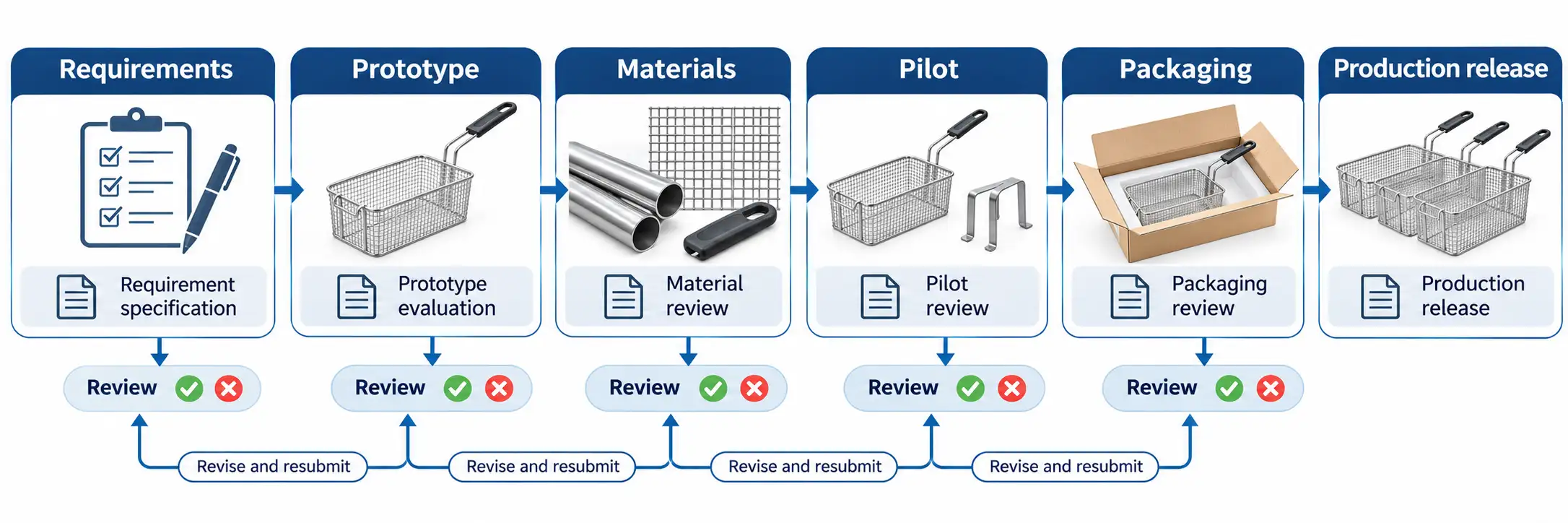
Use a checklist with explicit release evidence
|
Approval stage |
Evidence required |
Decision before proceeding |
|
Requirements |
Application and unresolved-item list |
Owners accept the defined scope |
|
Prototype |
Identified sample and measured review |
Design issues closed or explicitly held |
|
Materials |
Approved construction and traceable records |
Substitutions and evidence gaps resolved |
|
Pilot |
Production-route results and corrections |
Repeatability concerns addressed |
|
Packaging |
Approved pack and relevant validation |
Transport and identification requirements met |
|
Production release |
Current documents and signed decision |
Authorized quantity and revision confirmed |
Use this as a project checklist, then add the specific test reports, drawings, and acceptance criteria. A tick without a document reference or a responsible approver provides little protection when a disagreement appears later.
Define conditional approval carefully. State what may proceed, what remains prohibited, which quantity is affected, and when the outstanding evidence is due. A limited pilot authorization should not become a blanket mass-production release.
Approve packaging and identification before dispatch
Review the pack with the actual production accessory. Check internal restraint, protection of projecting features, carton quantity, labels, and pallet layout where applicable. Include unpacking and stock identification in the review so the pack works at the receiving warehouse.
Match transport validation to the intended route. A pack suitable for one distribution method may need reassessment for another. Agree the evaluation with a packaging specialist and define product damage criteria before the trial, not after seeing the results.
Labels should distinguish model, revision where required, quantity, and lot reference. Mixed shipments need a clear packing list and separation between visually similar variants. Traceability should survive repacking through an agreed method rather than depending on the original outer carton remaining intact.
Release production and control later changes
The release record should identify the approved revision, authorized quantity, applicable inspection plan, packaging specification, and required documentation. Make the supplier’s production team work from that current set. Remove obsolete instructions from points of use.
Agree a written change-notification process. Changes to materials, tooling, manufacturing location, critical process settings, purchased components, or packaging should be reviewed when they can affect approved requirements. Define who decides whether new samples, testing, or customer approval are necessary.
For repeat orders, compare the requested configuration with the last approved revision. An unchanged sales model name does not prove the construction is unchanged. Ask the supplier to identify proposed changes before the order is released.
Set a clear rule for deviations discovered during production. Record the affected feature, quantity, reason, and proposed disposition, then obtain the designated approval before shipment. Include an expiry or order limitation where the concession is temporary. This keeps an exceptional decision from becoming the normal specification on the next reorder.
For dimensions that are checked at both factories, agree the measurement setup before comparing results. Different reference surfaces, assembly states, or fixtures can produce disagreement even when both teams use calibrated instruments. Resolve the method during sample approval and retain it with the inspection instruction. A shared method makes later receiving discussions more productive and helps distinguish a real manufacturing change from a difference in measurement practice.
Close the first shipment with receiving feedback
At receipt, confirm identification, quantity, transport condition, and agreed critical characteristics. Keep affected stock separate when a discrepancy appears. Preserve the sample, report, and packaging evidence needed to investigate the issue.
Review the first production shipment with engineering, quality, purchasing, and the supplier. Record which requirements were met, what remained difficult to inspect, and what corrective actions require verification on the next run. Update controlled documents so useful findings become part of the process.
To begin an OEM project with Simple, send the accessory design and approval checklist with expected quantities, target equipment, destination markets, and required evidence. Request a proposed sample and pilot route, then agree the approval responsibilities before authorizing mass production.
FAQ
Does an approved prototype authorize mass production
Only if the approval explicitly covers that decision and all required evidence is complete. Keep design acceptance and production release clearly identified.
Must a pilot use final tooling
It should represent the intended production route. Record any tooling differences and decide what further verification is needed before release.
Who should sign the approval checklist
Assign authority by subject. Engineering, quality, compliance, packaging, and purchasing may each need to approve the requirements within their responsibility.
What happens when a supplier proposes a material change
Review the effect on fit, performance, manufacturing, and compliance. Complete the agreed evidence and authorization before using the changed construction.
Should repeat orders receive another prototype review
Not automatically. Use the agreed change-control plan and order review to determine whether changes or past issues require renewed samples or testing.
