


5 días a la semana de 8:30 a 17:30

What Should Buyers Check in Fryer Basket Welds and Frame Reinforcement Before Bulk Ordering?
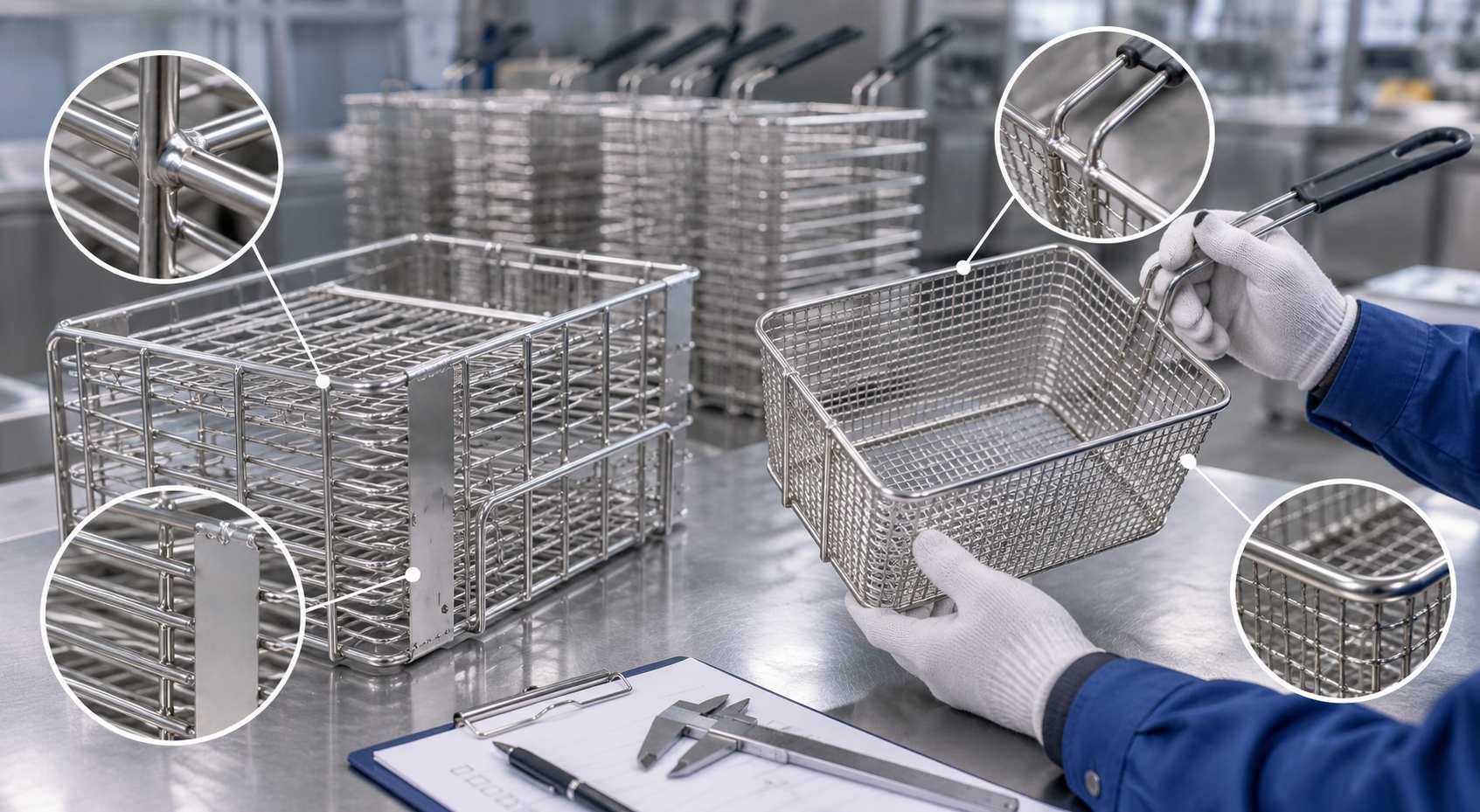
A commercial fryer basket may match the required dimensions and material yet still become a poor bulk purchase if its joints, frame, or wire connections are inconsistent. Purchasing managers and technical buyers therefore need to inspect how the basket is built, not only how it looks. Weld condition, frame rigidity, reinforcement placement, and sample consistency affect whether baskets keep their shape through repeated loading, lifting, draining, and cleaning. The inspection goal is to turn those details into acceptance points that can be reproduced and checked.
Which Areas of a Fryer Basket Carry the Most Structural Stress?
Food weight moves through the bottom mesh into the side walls and upper frame, while lifting transfers force toward the handle connection. These load paths show which joints deserve the closest attention.
Upper Frame and Bottom Support
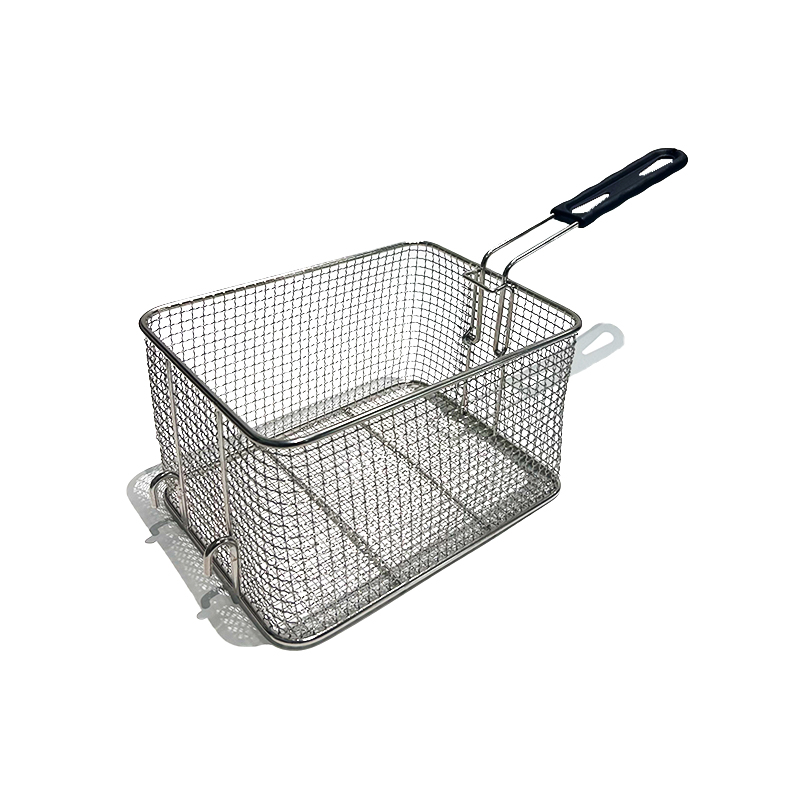
The upper frame controls the basket opening and helps the side walls resist spreading. Check whether it remains straight, whether corners meet cleanly, and whether the mesh is attached consistently around the perimeter. A slightly twisted frame may still look acceptable on a table but later rub against the fryer or hang unevenly.
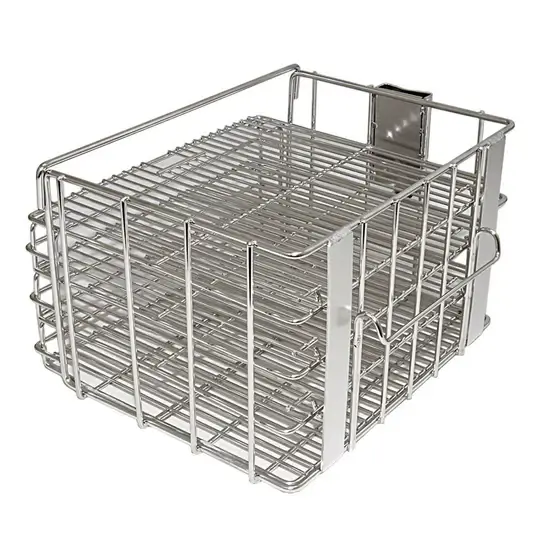
Larger or deeper baskets may use extra support beneath the bottom. The question is not simply whether a crossbar exists, but whether it is positioned and attached without pulling the basket out of shape. After a representative loading check, place the sample on a flat reference surface and compare the bottom and opening with the original record.
Inspection criteria should follow the actual basket drawing rather than one generic rule. When reviewing a commercial fryer basket range, note which structural details change with basket size, depth, and intended fryer type.
What Does a Useful Weld Inspection Look Like Before Mass Production?
Weld inspection should separate structural concerns from cosmetic differences. A dark heat mark does not automatically mean a weak joint, while a neat-looking spot may still be inadequate if connected wires move during handling. Buyers need repeatable workmanship criteria tied to the exact basket construction.
|
Inspection Point |
Qué buscar |
Purchasing Concern |
|
Wire-to-frame joint |
Stable attachment, no separation |
Loose mesh or changing geometry |
|
Corner joint |
Alignment without cracking |
Frame distortion |
|
Bottom support joint |
Even attachment and position |
Uneven load transfer |
|
Weld surface |
No harmful sharp projection |
Handling and cleaning difficulty |
|
Adjacent wire |
No obvious burn-through |
Reduced section near the joint |
Both sides should apply the table to the same approved sample so cosmetic variation is not confused with structural movement.
Why Should Several Joints Be Checked?
A basket contains many repeated connections, so consistency matters as much as the strongest individual joint. Inspect points around the upper frame, sides, bottom, and reinforcement areas. If one region repeatedly shows different alignment or finishing, the variation may be linked to the production sequence rather than a single defect.
Incoming inspection should follow the buyer’s normal sampling plan.
How Can Buyers Evaluate Reinforcement Without Over-Specifying the Design?
Requesting thicker wire or more reinforcement may not solve deformation because structural behavior also depends on basket size, support position, handle geometry, and load path.
The more useful approach is to define the working requirement and verify that the proposed construction remains stable under an agreed sample condition.
Check Squareness and Cleaning Access
Measure the basket opening using the controlled dimensions on the drawing and compare diagonals where appropriate. Repeat the same check after representative loading and handling to see whether the structure has taken a permanent set. The basket should also enter and hang in the intended fryer without scraping or requiring force.
Reinforcement should not create hard-to-clean pockets. Extra bars, overlapping wires, or crowded joints can trap crumbs and burnt residue. During sample review, inspect the underside and corner transitions after normal cleaning. The purchasing decision should balance rigidity, drainage, cleanability, and the intended menu.
Which Sample Tests Give Buyers Useful Evidence Before a Bulk Order?
A sample test should reflect the actual application. Load, repetitions, oil exposure, and cleaning method should come from the buyer’s operating conditions or an agreed project specification.
Record the new sample first: outside dimensions, opening geometry, handle position, frame alignment, and visible joint condition. Put the basket through representative loading and handling, then repeat the same checks.
A concise approval checklist may include:
-
Upper frame matches the approved geometry.
-
Basket opening remains within the agreed drawing requirement.
-
Wire-to-frame joints show no visible separation.
-
Bottom support stays aligned.
-
Reinforcement does not interfere with fryer clearance.
-
No sharp projections appear at welded areas.
-
Handle connection remains stable.
-
Basket drains and cleans without new residue traps.
-
Surface treatment matches the approved sample.
-
Dimensions are recorded for incoming inspection.
If a later shipment differs, purchasing and quality teams can compare it with a controlled reference instead of relying on memory.
What Should Be Frozen in the RFQ and Quality Agreement?
Once the sample passes inspection, the structural details should move into controlled purchasing documents. Otherwise, a supplier may reproduce the general appearance while changing wire diameter, support layout, joint position, or surface treatment in ways the buyer did not expect.
The RFQ or drawing should identify basket dimensions, material requirement, wire sizes where specified, upper-frame construction, reinforcement location, handle interface, surface treatment, and critical clearances. If substitutions are allowed, they should be approved explicitly.
For custom projects, the commercial kitchen customization process can support communication around drawings, samples, and required modifications. Buyers should also retain photographs of approved joints and reinforcement areas because some workmanship details are easier to compare visually than to describe in one sentence.
Incoming inspection can focus on the features most likely to affect fit and durability.
Professional Technical Support from Foshan Simple Technology Co., Ltd.
Foshan Tecnología Simple Co., Ltd. supplies commercial kitchen components for OEM, distribution, and replacement programs, including stainless-steel and plated fryer basket constructions in multiple sizes and configurations. Its website lists models for electric fryers, pressure fryers, and large-capacity foodservice applications, with product pages identifying material and surface-treatment options. One example is the YW-004 Heavy Deep Wire Frying Basket, whose page lists several basket sizes, nickel-plated, 201 stainless steel and 304 stainless steel options, electroplating or electrolytic polishing, and a reinforced bottom crossbar. For OEM purchasing, the approved drawing and sample should remain the controlling references.
Conclusión
Fryer basket structural quality is easier to control when welds and reinforcement are translated into measurable approval points. Buyers should examine the upper frame, repeated wire joints, corners, bottom supports, handle connection, and basket geometry before and after a representative sample test. Once the construction is accepted, freeze the relevant dimensions, materials, reinforcement layout, surface treatment, and workmanship references in the purchasing documents. This gives the supplier a clear production target and incoming quality teams a practical basis for identifying meaningful variation.
Preguntas frecuentes
1. Should every visible weld mark on a fryer basket be treated as a defect?
No. Surface discoloration or polishing marks do not automatically mean a weak joint. Buyers should focus on separation, cracks, movement, sharp projections, burn-through, distortion, and whether the connection matches the agreed sample.
2. How can buyers check whether a fryer basket frame is out of square?
Compare the approved opening dimensions and diagonal measurements, then repeat the check after representative loading and handling. A basket that changes shape or needs force to enter the fryer should be investigated before bulk production.
3. Does adding more reinforcement always make a fryer basket more durable?
Not necessarily. Reinforcement position, basket geometry, wire layout, joint quality, and load path all matter. Extra bars can also create cleaning problems or interfere with fryer clearance if they are added without considering the complete design.
4. What should be recorded during fryer basket sample approval?
Record dimensions, frame alignment, joint condition, reinforcement position, handle stability, surface treatment, and the result of representative loading and cleaning. Photographs of critical joints are useful references for later incoming inspection.
5. Which fryer basket details should remain fixed after sample approval?
Critical dimensions, material requirements, specified wire sizes, frame construction, reinforcement layout, handle interface, surface treatment, and agreed workmanship references should be controlled. Any later substitution should be reviewed before production.
