


5 jours par semaine de 8h30 à 17h30

Preventing Adjustable Leg Mix-Ups in Multi-Model OEM Production
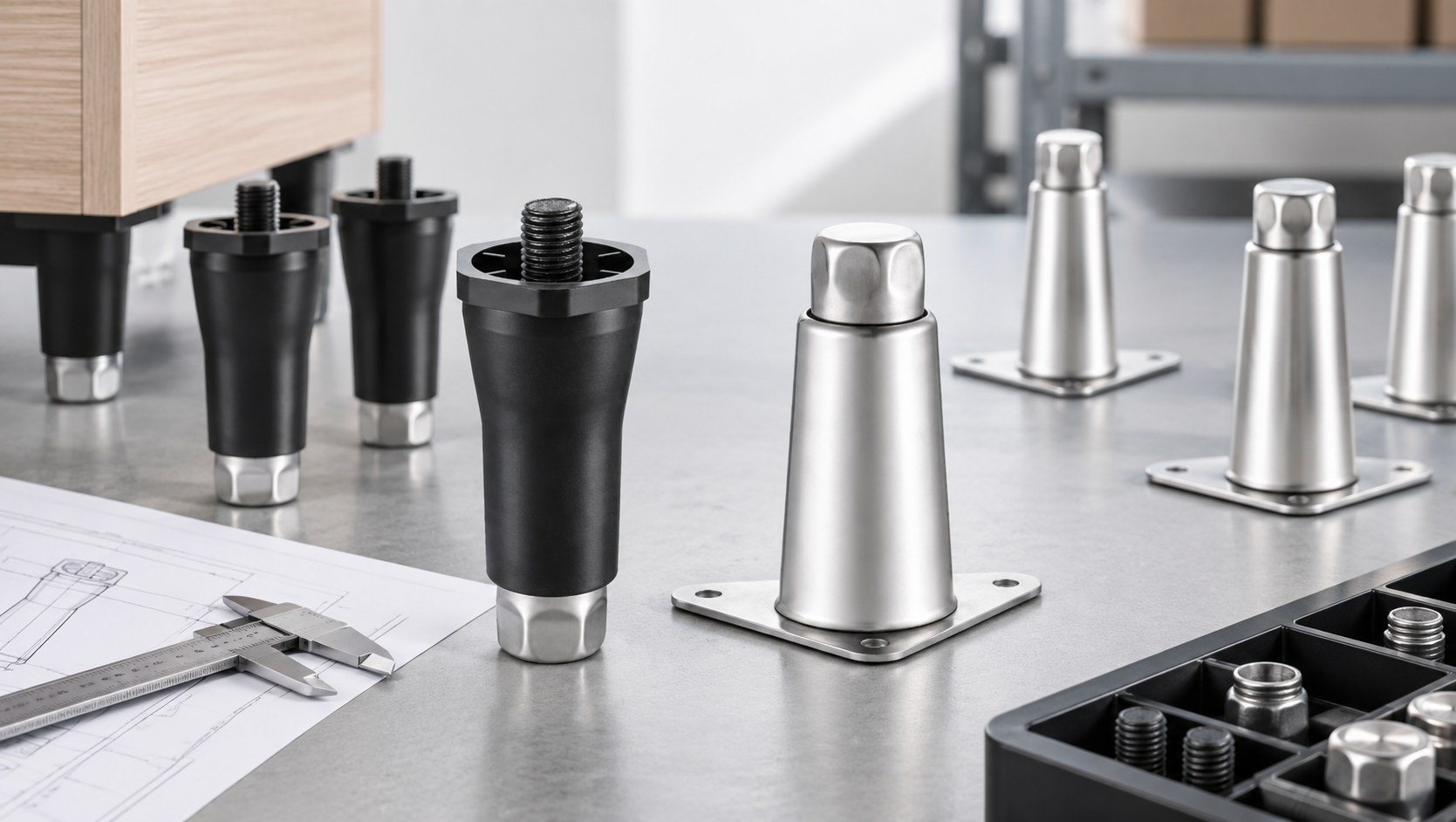
An adjustable equipment leg may be technically correct and still become the wrong part on an OEM assembly line if several similar versions are stored, packed, or labeled without a clear identification system. This problem becomes more common when one manufacturer produces refrigerators, worktables, ovens, steam cabinets, or other equipment that use legs with similar appearance but different heights, mounting structures, threads, or materials. For purchasing and production teams, the risk is not limited to warehouse confusion. A mixed part can reach final assembly, cause rework, affect equipment height, or remain unnoticed until installation. Preventing that situation requires part identification, drawing control, supplier labeling, and receiving checks to work together.
Why do similar adjustable legs create a high risk of part mix-ups?
Adjustable legs are often visually similar. Two versions may use the same stainless-steel tube diameter and finish while differing only in total height, mounting plate geometry, thread arrangement, or adjustment range. Those differences may not be obvious to a warehouse operator looking at several cartons.
The problem becomes more serious when multiple equipment models share the same production facility. One line may require a shorter leg for an undercounter refrigerator while another needs a taller version for a worktable. If both parts are stored under informal descriptions such as “stainless adjustable leg,” the description itself does not prevent a picking error.
Buyers working with commercial kitchen adjustable legs should therefore treat identification as part of the specification.
A visual resemblance should never be the primary identifier
Part identification should begin with a unique internal code linked to one approved drawing. That code should appear consistently on the purchase order, supplier label, packing list, receiving record, and warehouse location.
The description can still include useful features such as height, material, mounting type, or application, but those details should support the part code rather than replace it.
For example, “150 mm stainless leg” is not enough when two models share the same nominal height but use different mounting arrangements.
The safer rule is simple: one controlled specification should have one controlled part number.
What information should appear on supplier labels and cartons?
A supplier label has to help both receiving staff and production workers identify the part without opening several cartons or comparing the component with photographs.
The exact format can follow the buyer’s own system, but the information should remain consistent from order to order.
A practical label can contain:
|
Label Field |
Pourquoi ça compte |
|
Buyer part number |
Main internal reference |
|
Supplier part reference |
Traceability to supplier |
|
Product description |
Quick visual confirmation |
|
Drawing revision |
Prevents old and new versions mixing |
|
Quantity |
Receiving and inventory control |
|
Batch or lot reference |
Supports investigation |
|
Purchase order |
Links shipment to sourcing record |
|
Carton number |
Helps isolate mixed cartons |
The most important point is that labels should not depend only on supplier terminology. If the buyer calls one component AL-105 while the supplier calls it BHXX, both references can appear, but the buyer’s controlled number should remain clear.
Inner packaging may need identification too
A master carton label is useful until the carton is opened. If parts are divided into inner bags or smaller boxes, those inner packages may also need identification.
This becomes important when a carton is moved to a production supermarket or partially consumed over several shifts. Once the outer box is discarded, unidentified inner packs can become a new source of confusion.
Where several customized parts are supplied under one OEM program, the customization process can be used to align drawing references, product codes, and packaging requirements before production.
How should drawing revisions be linked to adjustable leg part numbers?
A part number loses value if multiple different drawings circulate under the same reference without clear revision control.
Suppose the buyer approves an adjustable leg and later changes the mounting plate thickness or installed height. If the supplier updates the drawing but the warehouse still holds old stock under the same label, both versions may enter production together.
The purchasing team needs to decide whether a change creates a new revision or a completely new part number.
Changes that affect fit should receive stronger control
Not every cosmetic adjustment needs a new item code, but dimensional or interface changes should never be hidden behind an unchanged description.
Review changes such as:
- total leg height;
- mounting plate geometry;
- hole pattern
- thread diameter or pitch;
- adjustment range;
- tube dimensions;
- base construction;
- material requirement.
If the new version cannot be freely substituted for the old version in every approved equipment model, a new part number is usually easier to control than relying only on a revision letter.
The approved drawing should clearly show its revision status, and the purchase order should reference the same revision where the buyer’s system requires it.
This is particularly useful when sourcing several parts through a broader commercial kitchen product center, because visually similar components can otherwise be treated as interchangeable when they are not.
What should receiving teams verify before adjustable legs enter warehouse stock?
Receiving inspection does not need to repeat a full engineering approval for every shipment. Its job is to confirm that the delivered product corresponds to the item ordered and that no obvious mix-up occurred before the stock is released.
Start with documents and labels before measuring parts.
Compare the purchase order, carton label, packing list, internal part number, supplier reference, and drawing revision. If those references do not agree, the discrepancy should be resolved before the carton is merged with existing stock.
Use a few distinguishing features for quick verification
For similar adjustable legs, receiving staff can verify a limited number of characteristics that separate one SKU from another.
Those may include:
nominal overall height;
mounting plate shape;
number of fixing holes;
tube diameter;
base style;
visible thread size;
finish or material where visually distinguishable.
The goal is not to replace drawing inspection with a visual check. It is to detect a wrong SKU quickly.
A photograph of each approved part stored beside the internal specification can also help warehouse personnel, provided the photo is not treated as the only technical reference.
If mixed parts are discovered, the receiving record should preserve the carton number or batch identification so purchasing can determine whether the problem affects one package or the entire shipment.
How can kitting and line-side control prevent the wrong leg from reaching assembly?
Correct warehouse stock can still be mixed during picking. When several equipment models are built in parallel, line-side controls become as important as supplier labels.
A good kitting system gives production workers only the part required for the specific equipment order or work instruction.
Match the leg code to the equipment bill of materials
The adjustable leg should appear on the bill of materials under the same controlled part number used by purchasing and inventory.
The work instruction can then identify the required quantity per equipment unit. For example, if one model uses four identical legs, the kit contains four pieces under one code. If front and rear supports differ, they should have separate references.
Avoid production instructions such as “use tall leg” or “use stainless leg.” Those descriptions are easy to misunderstand when new variants are introduced.
Line-side bins should also carry the controlled part number. If two similar legs must be stored near each other, physical separation and clear labels reduce the chance of an operator grabbing the wrong component.
A simple control sequence is:
- Purchase order uses the controlled part number.
- Supplier carton shows the same reference.
- Receiving verifies label and revision.
- Warehouse location is assigned by part number.
- Production kit is created from the equipment BOM.
- Line-side bin carries the correct code.
- First assembly confirms the intended component.
- Mixed or unidentified stock is quarantined.
These controls are inexpensive compared with finding the wrong support component after the equipment has already been packed.
What records help buyers investigate a recurring mix-up?
When a wrong component appears in production, the investigation should determine where the identification chain failed rather than simply replacing the part and continuing.
Useful records include the purchase order, supplier packing list, carton photographs, receiving record, warehouse transaction, picking record, production order, and approved drawing.
If the part carries a batch reference, the buyer can determine whether other cartons from the same shipment should be checked.
The investigation should ask whether the supplier packed the wrong item, whether two labels were swapped, whether warehouse stock was combined, or whether the production BOM contained the wrong part number.
Correct the system, not only the individual carton
If the same mix-up happens more than once, adding another verbal reminder usually does not solve it.
The stronger response may be to create a new part code, improve label contrast, change warehouse locations, add an inner-pack label, or revise the BOM.
The objective is to make the wrong choice difficult.
For OEM purchasing, traceability does not need to become overly complicated. It simply needs to connect the physical adjustable leg to the drawing and equipment model for which it was approved.
Professional Technical Support from Foshan Simple Technology Co., Ltd.
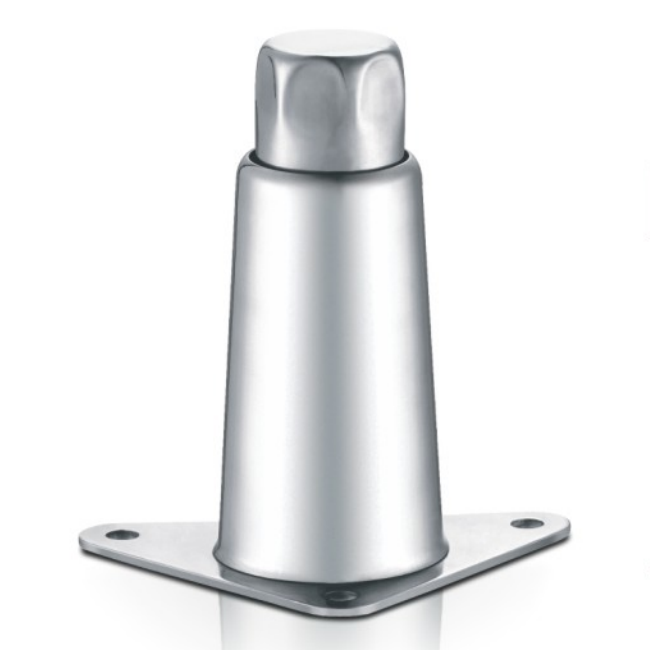
Foshan Simple Technology Co., Ltd. supplies commercial kitchen components for OEM, distribution, and equipment-production projects, including adjustable legs in multiple sizes and mounting configurations. Its product range includes models for refrigeration equipment, worktables, ovens, steam cabinets, and other commercial kitchen frames. One example is the BH01 Stainless Steel Adjustable Leg. For projects using several similar leg versions, buyers can provide equipment drawings, product references, quantities, packaging instructions, and labeling requirements so each approved configuration remains identifiable through ordering, packing, receiving, and assembly.
Conclusion
Adjustable leg mix-ups are usually an information-control problem rather than a component-quality problem. When several similar versions enter one OEM program, every approved configuration should have a unique part reference connected to a controlled drawing, supplier label, warehouse location, and equipment bill of materials. Receiving teams should verify a few distinguishing features before stock is released, while production should pick from clearly identified kits or bins. A consistent identification chain makes it easier to prevent wrong-part assembly and much faster to trace the source when a discrepancy occurs.
Questions fréquentes
1. Can two similar adjustable legs use the same internal part number?
Only if they are completely interchangeable under the buyer’s approved specification. If differences in mounting, height, thread, material, or adjustment affect equipment compatibility, separate part numbers provide clearer control.
2. Should the drawing revision appear on the carton label?
For OEM programs where revisions affect compatibility, including the drawing revision can help prevent old and new versions from being mixed. The buyer should define the required label format before ordering.
3. What should receiving staff check first?
Start with the purchase order, part number, supplier reference, carton label, quantity, and revision information. Then verify a few distinguishing physical features before releasing the stock.
4. How can factories reduce line-side part picking mistakes?
Use equipment bills of materials, kitted quantities, clearly labeled bins, and unique part codes. Avoid informal descriptions such as “short leg” or “stainless leg” when several similar versions exist.
5. What should buyers do if mixed adjustable legs are found in one shipment?
Quarantine the affected stock, record carton and batch references, compare the parts with approved drawings, and trace packing and receiving records before releasing any remaining cartons.
