


5 dias por semana das 8:30 às 17:30

Wire Diameter Matters: Choosing the Right Fan Guard Strength
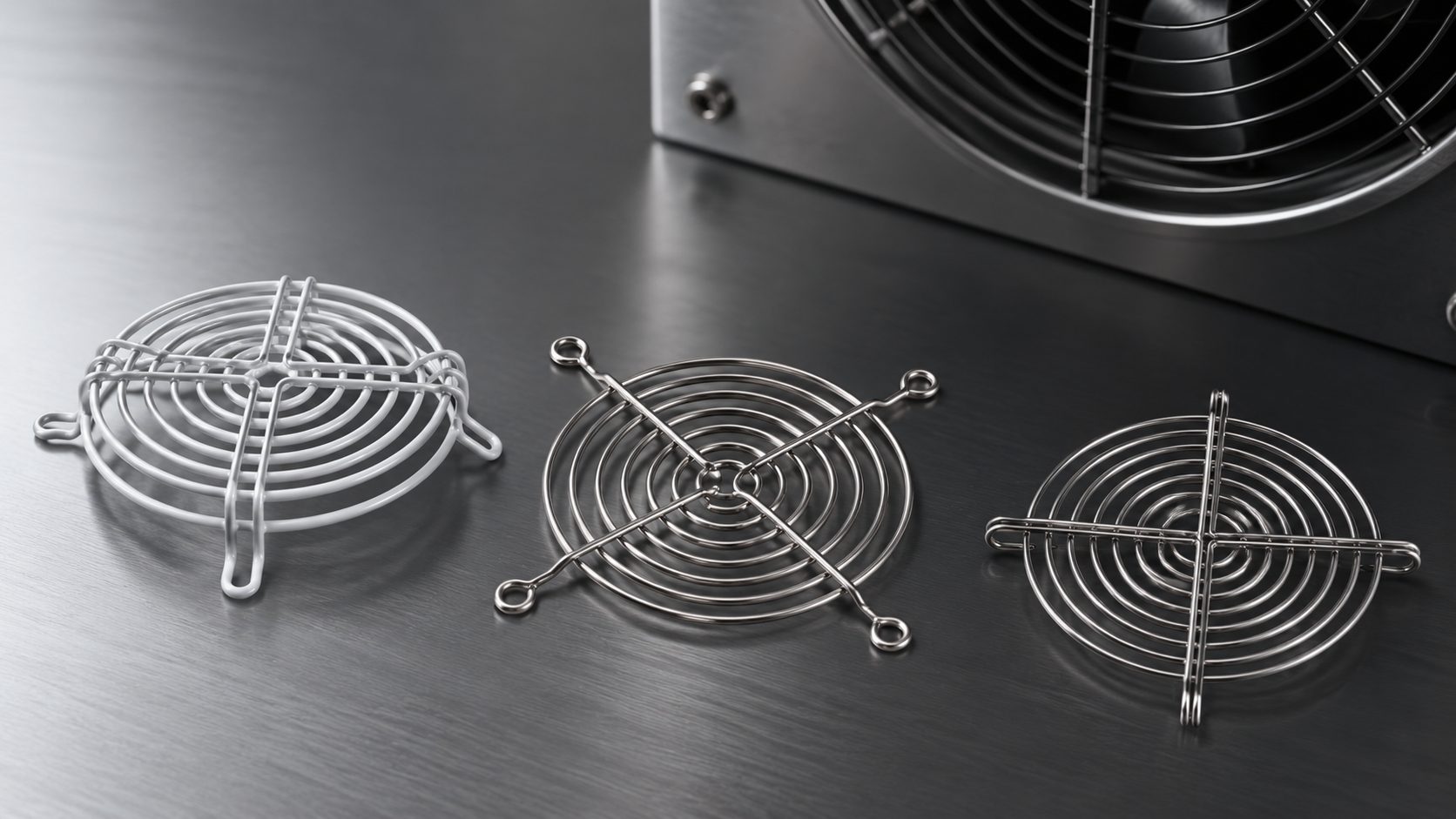
For commercial kitchen equipment manufacturers and replacement-parts buyers, fan guard strength cannot be judged from outer diameter alone. Two wire fan guards may fit the same fan yet behave very differently under cleaning, vibration, accidental contact, and long-term use. Wire diameter affects rigidity, but it also influences open area, weight, welding requirements, and cost. The buying decision should therefore be based on the complete guard structure rather than simply selecting the thickest wire available. A good specification links wire diameter to fan size, guard span, mounting layout, clearance, material, and the level of mechanical protection required.
How Much Does Wire Diameter Really Affect Fan Guard Strength?
Wire diameter has a direct influence on how resistant an individual wire is to bending. A thicker wire generally feels more rigid when the same force is applied.
That principle is useful, but it can be misleading when buyers compare complete fan guards.
A guard is not one wire. It is a structure made from rings, radial wires, cross wires, weld points, an outside frame, and mounting features. All of those parts distribute load.
For example, a guard using moderately sized wire with several support rings may remain more stable than a design that uses thicker wire but fewer structural connections.
Guard diameter also matters. As the span increases, the center section generally becomes harder to keep rigid. A wire size suitable for a compact fan guard may not provide the same stiffness on a much larger guard.
When requesting quotations, buyers should avoid descriptions such as: heavy-duty wire fan guard.
That wording cannot be inspected consistently.
Instead, specify:
-
Overall guard diameter or width × height
-
Main wire diameter
-
Frame wire diameter
-
Number and arrangement of support rings
-
Mounting configuration
-
Material and finish
These values give both the supplier and the incoming quality team something measurable.
Is Thicker Wire Always the Better Choice for Commercial Kitchen Equipment?
No. The correct wire diameter is the one that provides enough structural strength without creating unnecessary trade-offs.
One trade-off is open area.
A fan guard sits in the airflow path. Increasing wire diameter while keeping the same spacing reduces the amount of open space through which air can pass.
The effect depends on the whole design, so buyers should not assume that a small increase in wire size will automatically create a ventilation problem. However, airflow should still be considered when comparing substantially different guard structures.
Weight and material cost also increase with heavier wire.
On one small guard, that difference may be insignificant. Across a large OEM order, unnecessary material can affect component cost and shipping weight without improving the equipment in a useful way.
Manufacturing quality is another limitation.
A thicker wire does not compensate for:
-
Incomplete welds
-
Weak mounting tabs
-
Distorted frames
-
Inconsistent spacing
-
Poor forming accuracy
The purchasing goal should therefore be “sufficient rigidity for the application,” not “maximum possible wire thickness.”
Which Parameters Matter Besides Wire Diameter?
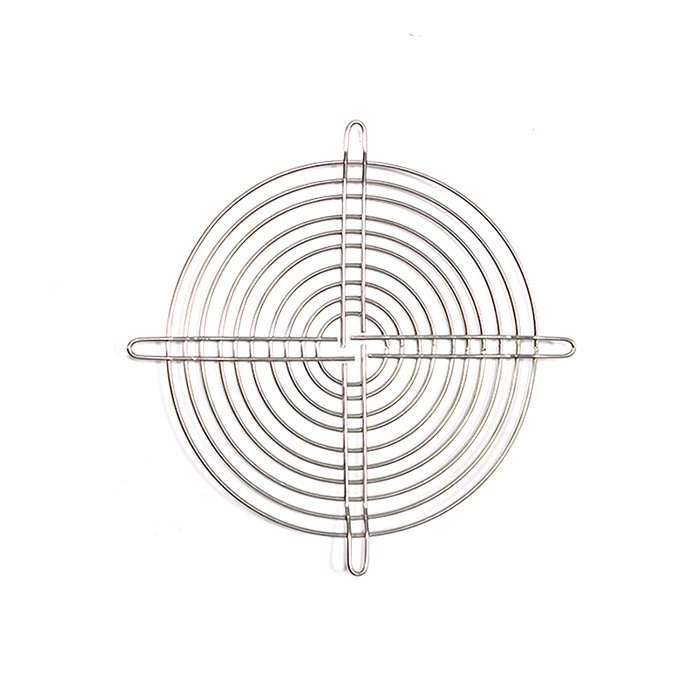
Wire diameter becomes much more useful when it is reviewed alongside the rest of the fan guard specification.
Guard span
Larger guards usually require more attention to structural support because the unsupported distance between mounting areas can increase.
Ring and spoke arrangement
Additional rings or radial supports can change how force is distributed through the guard.
Weld quality
Wire intersections need consistent joints. A guard built from strong wire can still fail at an unreliable weld.
Mounting points
The fan guard must remain secure after installation. Buyers should check hole diameter, hole spacing, mounting-tab strength, and alignment.
Fan clearance
The guard must not contact rotating blades during operation, vibration, or routine handling.
Material
Stainless steel, coated steel, and other materials behave differently in greasy, humid, or frequently cleaned environments.
A useful sample inspection should therefore include more than pushing on the center of the guard.
Check whether the frame remains flat, whether the mounting points stay aligned, whether any welded intersections move, and whether clearance remains sufficient once the fan is operating.
What Should OEM Buyers Put on a Fan Guard Drawing or Purchase Specification?
A purchase order based only on fan diameter creates too much room for interpretation.
An OEM drawing should ideally include:
| Elemento | What to specify |
|---|---|
| Overall dimensions | Diameter or width × height |
| Guard profile | Flat, raised, convex, or custom |
| Main wire | Diameter |
| Frame wire | Diameter if different |
| Support layout | Ring and spoke arrangement |
| Mounting holes | Diameter and center spacing |
| Material | Exact requested material |
| Surface finish | If applicable |
| Fan clearance | Required installation separation |
| Quantity | Prototype, sample, or production volume |
Application information should be supplied as well.
Tell the supplier whether the fan guard will be used around refrigeration equipment, a ventilation assembly, or another commercial kitchen machine. Explain whether the area is greasy, humid, hot, frequently washed, or routinely accessed by staff.
For replacement projects, photographs alone are not enough. Buyers should also measure mounting points and available installation depth.
Before approving a bulk order, fit a sample to the actual equipment and check:
-
Mounting alignment
-
Guard rigidity
-
Fan blade clearance
-
Vibration during operation
-
Weld condition
-
Ease of removal and cleaning
That sample can then become the reference for later production.
How Can Buyers Compare Fan Guard Suppliers More Effectively?
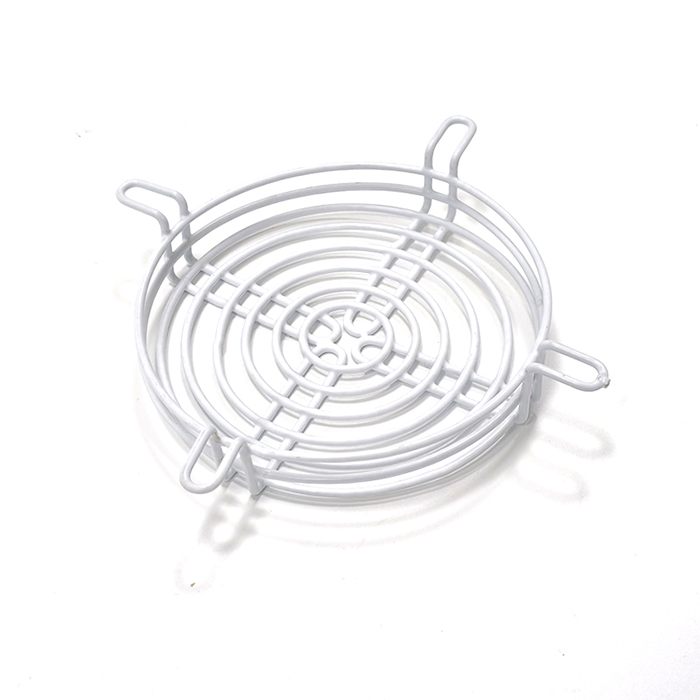
Price comparison becomes useful only after the suppliers are quoting the same product specification.
If one quotation uses thicker wire, another uses a different material, and a third changes the mounting structure, the prices are not directly comparable.
A better supplier evaluation asks for the same measurable information from each source.
Useful questions include:
-
What wire diameter is used for the mesh?
-
Is the frame wire the same diameter?
-
Which material is used?
-
How are the wire intersections joined?
-
What dimensional tolerances can be maintained?
-
Can mounting positions be customized?
-
Can a pre-production sample be supplied?
-
How is repeat-order consistency checked?
Incoming inspection should then compare production parts with the approved drawing or sample.
This is especially important for distributors and OEM manufacturers because an inconsistent mounting hole or distorted frame can stop assembly even when the basic wire material is acceptable.
How Does Foshan Simple Technology Co., Ltd. Support Wire Fan Guard Projects?
Foshan Simple Technology Co., Ltd. supplies commercial kitchen equipment components for OEM manufacturers, distributors, and replacement-parts buyers. For wire fan guards, the useful specification includes more than outside diameter: wire size, structural layout, mounting position, guard profile, material, finish, and fan clearance can all affect whether a part works correctly on the intended equipment. Buyers can use drawings, measurements, or existing samples to communicate these requirements before production. This approach is especially useful for replacement projects and repeat OEM orders where dimensional consistency and compatibility with the existing fan assembly matter.
Conclusão
Wire diameter matters, but it is only one part of fan guard strength. Buyers should evaluate wire size together with guard span, support layout, weld quality, mounting geometry, material, and fan clearance. The next step before ordering is to convert the application into a measurable drawing and approve a sample on the actual equipment. That gives purchasing teams a clear quality reference and reduces the risk of receiving a “strong” fan guard that does not fit or perform as expected.
FAQ
1. What wire diameter should I choose for a commercial fan guard?
There is no universal value. The suitable diameter depends on guard size, support layout, mounting method, material, fan clearance, and the amount of mechanical contact expected in service.
2. Does thicker wire make a fan guard block more airflow?
It can reduce open area when spacing remains unchanged. The practical airflow effect depends on the complete mesh geometry, fan size, guard position, and surrounding airflow path.
3. What is more important: wire diameter or weld quality?
Both matter. Wire diameter affects rigidity, while poor welds can weaken the entire structure. Buyers should inspect wire dimensions, weld consistency, mounting strength, and finished shape together.
4. What should I check on a fan guard sample?
Check dimensions, wire diameter, guard shape, mounting-hole position, welds, rigidity, blade clearance, and vibration after installation. Keep the approved sample or drawing for later incoming inspection.
5. Can fan guards be customized for OEM kitchen equipment?
Yes. Buyers can specify dimensions, wire size, support pattern, mounting points, guard profile, material, finish, and packaging. A detailed drawing or physical sample helps reduce interpretation errors.
