


5 dias por semana das 8:30 às 17:30

How to Specify CRI and R9 for Commercial Range Hood Lights
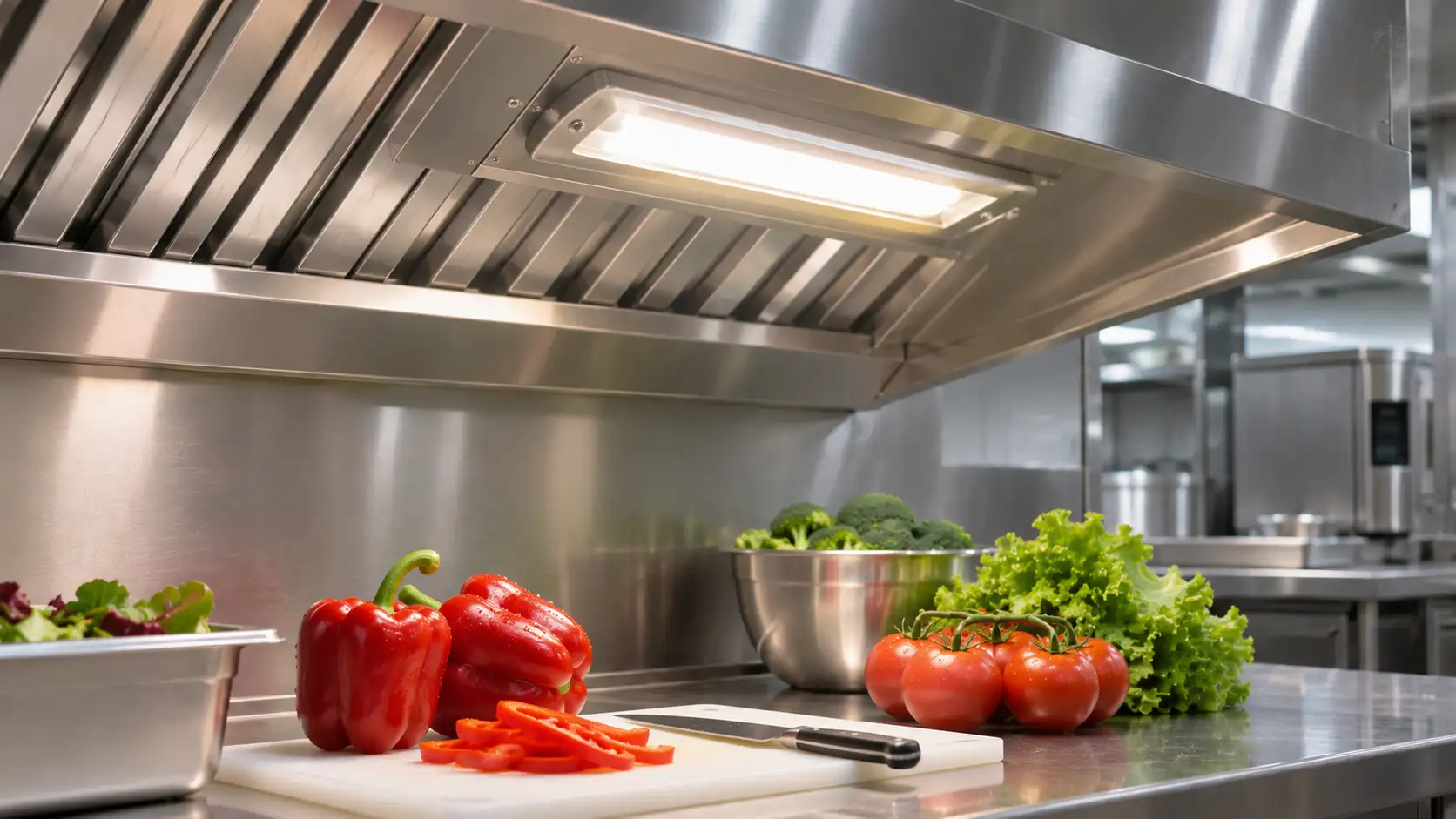
Specify commercial range hood lights with a documented general colour rendering index, Ra, and a separate R9 value when red colour rendition matters to the project. Review those figures alongside the selected colour temperature and the actual lamp assembly. Approve a representative sample under the intended hood conditions before freezing the lighting specification.
Two white lights can look similar when viewed directly yet make the same ingredients appear different. Buyers who record only wattage and colour temperature leave this aspect of the lighting decision open. CRI and R9 help make the requirement explicit and give suppliers a common basis for submitting evidence.
Distinguish white appearance from colour rendition
Correlated colour temperature, or CCT, describes the appearance of the white light. Colour rendition concerns how illuminated objects appear. Specify both when the lighting needs to support a consistent view of ingredients, equipment surfaces and the working area.
A rectangular commercial range hood LED light should be reviewed as an identified assembly with its selected LED option and cover. Record the model and drawing revision before attaching any colour requirement. Where dimensions or options need clarification, obtain the approved drawing with the quotation.
Keep light quantity and colour quality in separate fields. A lux reading documents illuminance at a location. It leaves the spectral information needed for colour-rendering evaluation unresolved. Record the intended work-plane illumination as part of the sample conditions so a brighter candidate does not dominate a visual comparison simply through its output.
Read Ra and R9 as separate results
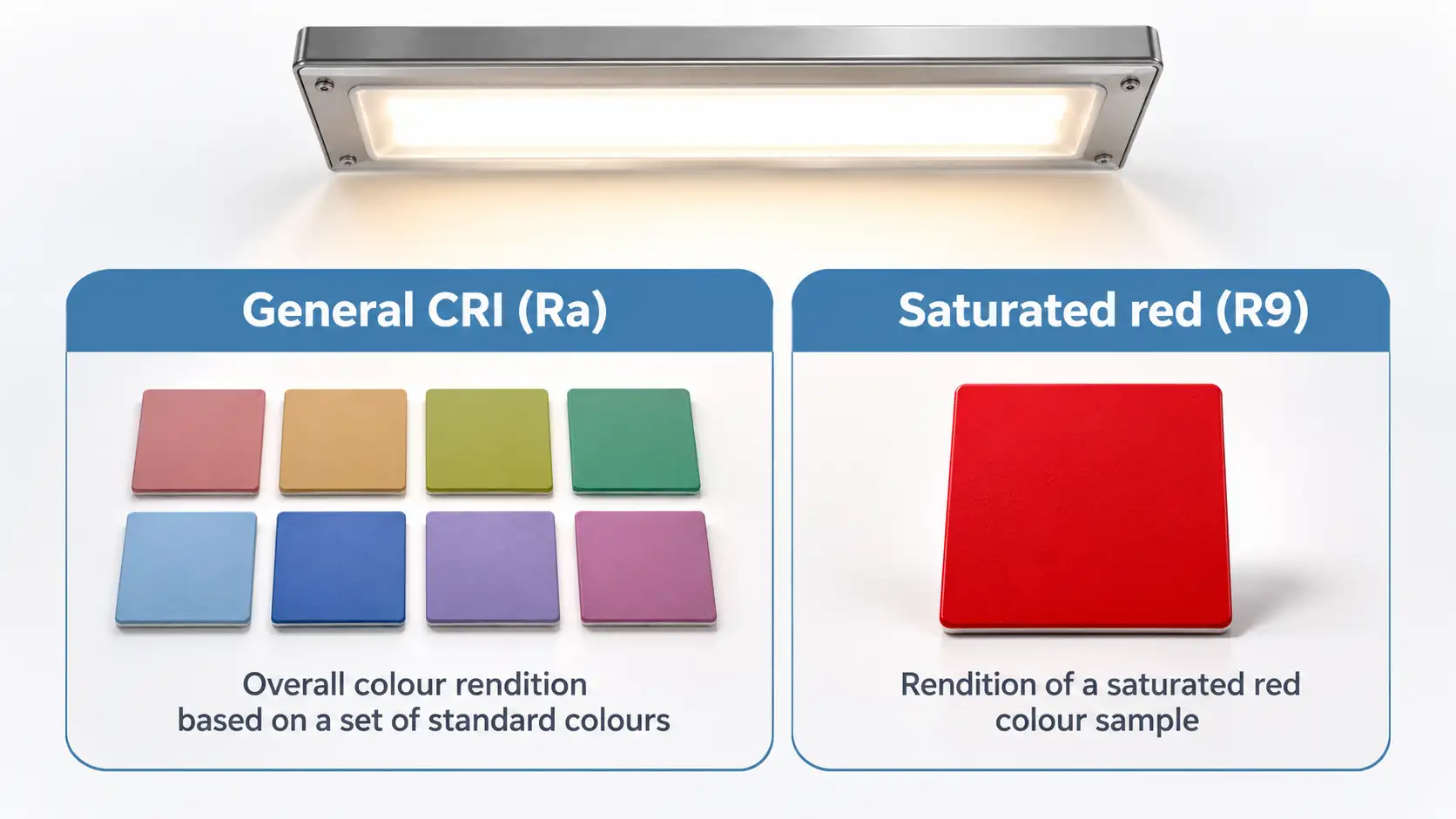
General CRI, commonly expressed as Ra, averages results for eight specified test colours. R9 evaluates a saturated red test colour and sits outside that eight-colour average. A reported Ra therefore leaves the R9 value unknown until it is supplied separately.
Use both values to describe the requirement you intend to approve. R9 adds information where saturated reds deserve attention. Ra remains useful for the broader fidelity comparison represented by its test colours. Neither value describes every aspect of how a kitchen will look under the installed lighting.
For example, two hypothetical lamps may both be offered at Ra 90 while their R9 values differ. The matching Ra entries leave room for a different saturated-red result. This is an illustrative purchasing situation, without measured results for any Simple model.
Negative R9 values are possible within the metric. Ask for the actual value when a quotation shows a dash, blank field or broad marketing label. Preserve the reported sign and precision in the comparison sheet.
Set project targets before comparing offers
Ask the lighting designer or equipment owner to define the required Ra, any R9 target and the acceptable CCT range. Record whether these are minimum values, nominal values or acceptance ranges. A minimum requirement needs evidence that addresses the agreed limit and its measurement conditions.
Avoid assigning one universal number to every commercial kitchen. The task, surrounding lighting, intended appearance and applicable project requirements influence the choice. Define who owns the decision and which documents will support final acceptance.
Keep the numerical request concise enough for a supplier to answer.
|
Specification field |
Information to agree |
Evidence to request |
|
General CRI |
Required Ra and acceptance basis |
Identified test result |
|
Saturated red |
R9 target where relevant |
Separate reported R9 value |
|
White appearance |
CCT option and permitted range |
Measured CCT for the sample |
|
Assembly identity |
LED, driver, cover and revision |
Bill of materials or controlled reference |
|
Visual approval |
Sample setup and responsible reviewer |
Recorded comparison decision |
Include a proposed deviation route. If a supplier can meet the Ra target but lacks an R9 result, the next action is to obtain evidence or submit the gap for project review. An empty field should remain visibly unresolved until that decision is recorded.
For repeat equipment programmes, use one specification template across the nominated fixture options. Include separate columns for the requested value, the supplier’s declaration and the measured sample result. This exposes a common documentation gap when a nominal catalogue figure is copied into the acceptance column without a corresponding sample reference.
Check which assembly the report represents
Request the report identifier, test date, measurement conditions and exact source identification. Establish whether the figures describe an LED component, a module or the complete luminaire. Carry the selected CCT option and electrical operating condition into that identification.
The optical path matters to the approval. A range hood light with a transparent glass cover should be evaluated with the specified cover fitted. If only component data are available, ask the supplier to identify the remaining evidence needed for the assembled sample.
Look for traceability between the laboratory sample and the proposed production parts. A report for a different LED option or cover leaves an approval gap. Request a documented explanation of its applicability or a measurement of the intended assembly.
Where the project uses TM-30, request its specified edition and report outputs as well. TM-30 provides several related measures and graphics for evaluating colour rendition. Have the lighting reviewer interpret those results within the project’s acceptance method. Record Ra and R9 explicitly when they remain part of the purchase specification.
Compare samples under controlled viewing conditions
Use the intended hood, cover position and work surface where practical. Clean the covers before comparison and let each lamp reach the operating condition defined by the test plan. Match the selected CCT and keep the surrounding lighting consistent.
Use representative ingredients and stable colour samples relevant to the task. Include saturated reds if R9 motivated the review. Keep the sample objects in the same position, with the same background and viewing distance. Check several locations across the working area because reflections and shadows can change the visual impression.
A side-by-side comparison needs care when the beams overlap. Arrange separate viewing areas or switch candidates under an agreed sequence so each is assessed under known conditions. Record illuminance at the comparison position and identify any difference that could influence the judgement.
Phone photographs can document the setup, fixture positions and sample labels. Automatic exposure and white balance can change their appearance. Keep the acceptance decision tied to the agreed measurement and viewing procedure, with photographs serving as supporting records.
Use the comparison to resolve the project’s appearance preference. A numerical score alone leaves the reviewer without a direct view of the intended working scene. Conversely, an attractive sample still needs traceable measurements when the purchase specifies numerical limits.
Record disagreement between reviewers instead of averaging their impressions into a new colour score. Ask which object, position or task produced the concern, then repeat that observation under the agreed conditions. A localized reflection may need a different follow-up from a consistent colour difference across several sample objects. The written observation should preserve that distinction.
Carry the approved colour specification into production
Retain the approved sample identifier, report, LED option, cover reference and drawing revision together. Record who approved the appearance and which deviations were accepted. Include the lighting configuration in the production order so the supplier can connect purchasing requirements to the actual build.
Agree how production consistency will be checked and how proposed component changes will be submitted. A different LED source or optical part needs review against the original colour requirements. Keep the supplier’s change notice and the owner’s decision with the same approval record.
For replacement orders, quote the approved configuration instead of relying on a description such as “white LED.” Match the CCT option, colour-rendering requirements and assembly reference. This gives service teams a practical starting point for maintaining a consistent appearance across a hood or equipment fleet.
Send Simple the intended hood arrangement, target Ra and R9, CCT option and sample-approval method. Request a range hood light specification review to establish which configuration and supporting colour data are available for your order.
FAQ
Does CRI 90 guarantee a high R9 value
Ra 90 identifies the general CRI result. Request R9 separately because it is outside the eight-colour Ra average. Keep both values in the approved specification when both are required.
Can equal CCT produce different food colours
Yes. Equal CCT can accompany different spectral distributions and colour-rendering results. Compare the documented metrics and representative samples under controlled conditions.
Is R9 a food safety test
R9 evaluates colour rendition for a specified saturated-red test colour. Food safety decisions require the applicable food-handling and verification procedures. Keep those procedures independent of lighting appearance approval.
Should every hood light have the same R9 target
Set the target through the project’s lighting review. Tasks, surrounding lighting and appearance requirements vary. Obtain the actual result and agree the acceptance basis before committing the order.
Can an LED component report approve the complete light
Check the report scope and project acceptance method. Component data can support selection, while the specified driver, cover and assembly still need an agreed basis for final approval.
