


5 дней в неделю с 8:30 до 17:30

How to Verify Replacement Fryer Basket Fit Before Ordering
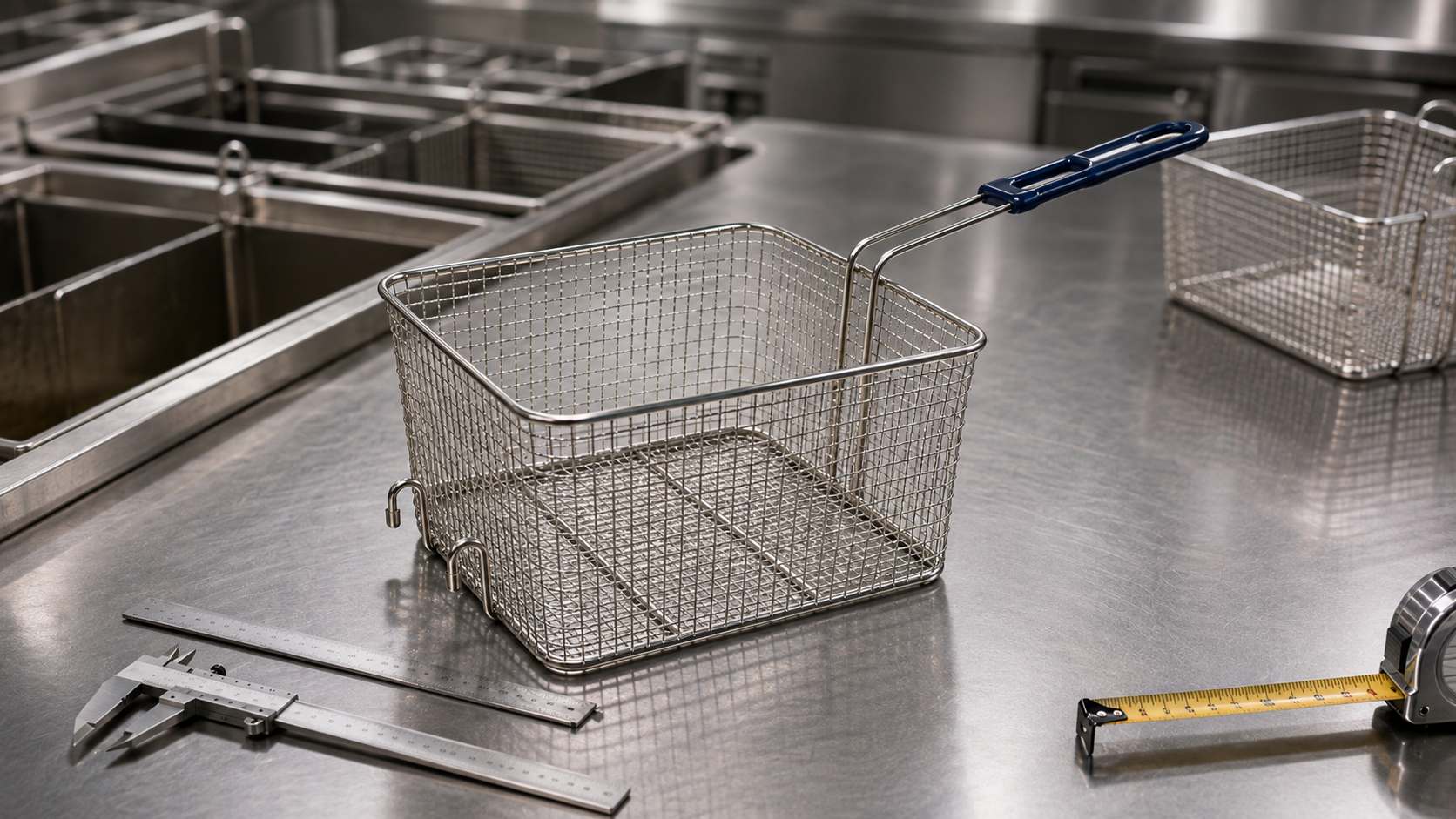
A replacement fryer basket should be verified against the fryer rather than selected from nominal length and width alone. For restaurant maintenance teams, fryer manufacturers, commercial kitchen distributors, and spare-parts buyers, compatibility depends on the basket body, usable vat space, handle angle, hanging hooks, support points, and operating movement. A basket can enter the fryer and still be the wrong replacement if its hook does not reach the hanger or its handle strikes the control panel. Because SPC Kitchen already has broader content on choosing a suitable fryer basket, this guide focuses specifically on the dimensional and mechanical checks buyers should complete before approving a replacement.
Which Fryer Basket Dimensions Should Be Recorded?
Start with the rigid upper frame rather than a section of wire that has been bent during service. Place the old basket on a flat surface and note which side faces the operator. If it is visibly distorted, measure several points before treating it as an accurate reference.
|
Measurement |
Where to measure |
Why it matters |
|
Top length |
Outer upper-frame edge |
Determines front-to-back clearance |
|
Top width |
Outer side edge |
Determines side clearance |
|
Basket depth |
Upper rim to lowest point |
Prevents contact with internal parts |
|
Bottom dimensions |
Lower basket body |
Important for tapered baskets |
|
Handle length |
Basket connection to grip end |
Affects working clearance |
|
Handle angle |
Relative to basket rim |
Affects controls and operator position |
|
Hook location |
From a fixed frame point |
Determines drainage-hanger fit |
|
Overall length |
Basket front to handle end |
Helps assess fryer-line clearance |
Why Measure Both the Top and Bottom?
Many fryer baskets taper toward the bottom. A buyer who measures only the top opening can miss interference lower in the vat. The basket may have enough clearance around the upper frame while the bottom corners touch an internal structure.
If the fryer uses two baskets side by side, measure both installed positions. Two baskets that fit individually may still interfere when lifted together.
How Should Buyers Check the Fryer Itself?
The relevant dimension is the usable fryer space, not the outside cabinet. Heating components, internal dividers, sensor assemblies, or tank geometry may reduce the clearance available to the basket.
Measure the usable opening width, front-to-back space, and vertical depth to the nearest internal obstruction. Compare those figures with the replacement basket drawing rather than relying on fryer cabinet dimensions.
Why Is There No Universal Clearance Number?
Commercial fryer designs vary too much for one clearance value to work everywhere. A basket needs enough room to enter, sit, lift, and drain without scraping the fryer or contacting internal parts, but excessive clearance can also allow unnecessary movement.
Where the original equipment documentation is available, use it as the primary dimensional reference. If it is not available, compare the existing basket, fryer opening, and proposed replacement together.
Menu capacity should be considered separately from fit. Buyers who also need to determine whether the basket size suits production volume can use the commercial fryer basket size guide after compatibility has been established.
Why Do Handle Geometry and Hooks Decide Whether a Basket Really Fits?
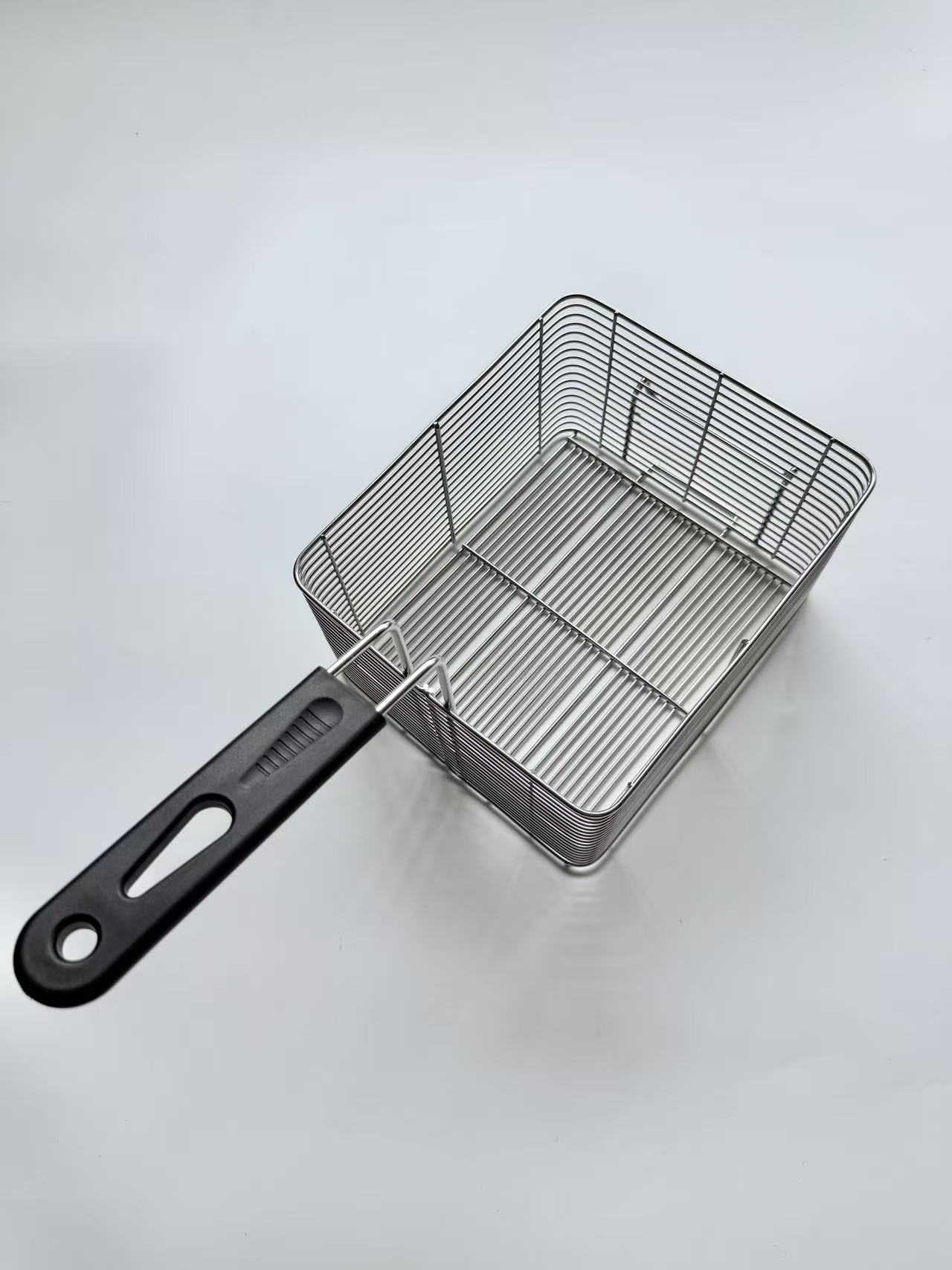
The basket body may occupy the correct space inside the vat while the handle or hooks make the replacement unusable. These components interact with the fryer during every cooking cycle, so they deserve separate measurements.
Handle Length and Angle
Compare the original and replacement from the side. A handle that rises too sharply may interfere with a control panel, splashback, shelf, or neighboring appliance. A handle that sits lower may change the operator’s working position around the hot fryer.
Measure the distance from the basket frame to the grip and record the handle angle. Overall length should also be checked where the fryer sits on a narrow cooking line.
Hanging Hook Position
Many fryer baskets are hung above the oil after cooking. The hook must line up with the intended support so that the basket remains stable while food drains.
Record the vertical and horizontal position of the hook relative to a fixed point on the upper frame. A small difference can determine whether the basket rests securely or hangs at an unintended angle.
The most useful reference photograph is therefore a side view of the original basket installed and hanging on the fryer.
Which Construction Details Should Be Checked After Fit Is Confirmed?
Mechanical compatibility is only the first stage. The basket still has to withstand repeated heating, loading, lifting, draining, and cleaning. Material, wire diameter, frame reinforcement, mesh spacing, weld quality, and handle attachment should therefore be compared after the dimensions are confirmed.
Material and Wire Construction
Material requirements should be written clearly in the RFQ. If a project specifies a particular stainless steel grade, do not leave the request as simply “stainless fryer basket.” Buyers comparing material options can refer to the existing 201 vs 304 fryer basket comparison.
Wire diameter and upper-frame reinforcement should match the expected food load. A basket used for light fries and one used for heavier products may occupy the same fryer but experience different mechanical stresses.
Welds and Deformation History
Inspect welds around the frame and handle connection. If existing baskets repeatedly deform at the same location, simply copying the old dimensions may reproduce the same problem. The article on why fryer baskets deform provides a separate framework for checking loading and structural causes.
What Should Buyers Include in a Replacement Fryer Basket RFQ?

A supplier should be able to understand both the basket and the fryer from the information provided. Include the fryer brand and model where known, but do not rely on the model number alone because equipment may have been modified or fitted with non-original baskets during its service life.
Provide top and bottom basket dimensions, depth, handle length and angle, hook location, fryer-opening dimensions, material requirements, expected load, and quantity. Photographs should show the empty fryer, the existing basket in its normal operating position, the basket hanging for drainage, and the old basket on a flat surface.
What Should Be Tested on a Sample?
For non-standard or higher-volume orders, fit a production-representative sample to a cold, safely isolated fryer. The basket should enter, sit, lift, hang, and come out without being bent or forced. Where the fryer uses two baskets, test both together.
-
Top and bottom dimensions match the drawing.
-
Basket clears fryer walls and internal parts.
-
Twin baskets operate without interference.
-
Handle clears controls and surrounding equipment.
-
Hanging hooks engage correctly.
-
Basket hangs securely for drainage.
-
Basket can be removed without twisting.
-
Material matches the RFQ.
-
Welds and frame remain straight.
-
Final dimensions are recorded for repeat orders.
The approval question is straightforward: can an operator use the replacement through every normal working position without modifying either the fryer or the basket?
How Does Foshan Simple Technology Co., Ltd. Support Fryer Basket Sourcing?
Foshan Simple Technology Co., Ltd. supplies commercial kitchen components including fryer baskets, grease filters, adjustable legs, bullet feet, and range hood lights. Buyers sourcing standard or replacement baskets can review the company’s commercial fryer basket range, which includes multiple basket constructions and dimensions. Where a specific replacement is being evaluated, product-level details can be compared only after fryer dimensions, handle geometry, hook position, material requirements, and operating conditions have been confirmed. Drawings, installed photographs, and existing samples provide a stronger basis for compatibility review than nominal basket size alone.
Вывод
A replacement fryer basket fits only when the basket body, fryer clearance, handle, hooks, and operating movement work together. Length and width alone are not enough. The buyer’s next step is to measure the basket and fryer separately, prepare a labeled drawing, and send installed photographs with the RFQ. For non-standard equipment or volume orders, test one representative sample before approving production. This is more reliable than assuming that two baskets with similar nominal dimensions are interchangeable.
Часто задаваемые вопросы
1. Are commercial fryer baskets universal?
No. Basket dimensions, depth, handle angle, hook location, frame geometry, and fryer-vat design vary between equipment.
2. What fryer basket dimensions should I measure?
Measure top and bottom length and width, basket depth, handle length, handle angle, hook location, and overall installed length.
3. Why does a replacement basket fit the vat but not hang correctly?
The hook position, frame geometry, or handle arrangement may differ from the original. Hanging compatibility needs to be checked separately from basket-body dimensions.
4. Can I use a slightly smaller fryer basket?
Possibly, but physical entry alone does not make it an equivalent replacement. Check stability, capacity, hooks, operating clearance, and twin-basket compatibility.
5. What information should I send the supplier?
Send basket dimensions, fryer-opening measurements, fryer model, handle and hook details, photographs, material requirements, quantity, and a drawing or reference sample.
