


5 дней в неделю с 8:30 до 17:30

How to Choose Grease Filter Handle Designs for Easier Cleaning and Replacement
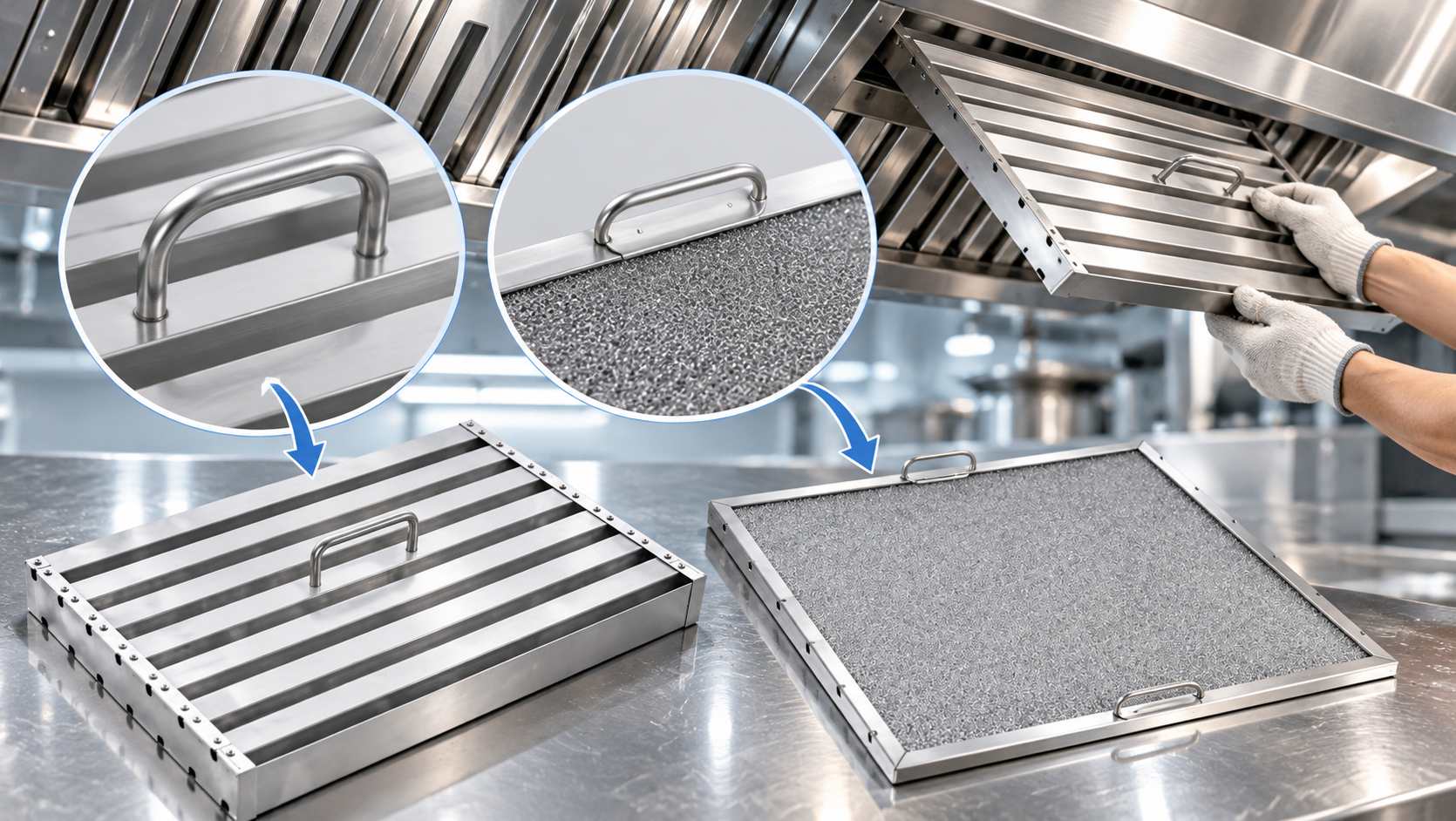
Even if the hood is perfectly fitted with a commercial grease filter, removal can be a challenge, not necessarily because of the frame of the filter or the retaining track of the filter, but more so the handle. A short handle placed near the upper rail of the hood can be problematic to grasp, whereas a protruding handle can interfere with adjacent grease filters, cleaning equipment etc. It is only when kitchen staff are constantly removing the filters for washing, that these small details become apparent. For hood manufacturers, kitchen contractors and commercial grease filter buyers alike, evaluating a handle for a grease filter involves several key factors, namely grip, position, hold, cleaning and installation.
Should Commercial Grease Filters Use Single or Double Handles?
One handle is typically sufficient for most grease filters; however, this may not always be the case for larger grease filters or specific installations.
Key considerations when selecting a filter include removal from hood, weight of filter, access to where it is to be installed and ability to operate it by maintenance personnel.
When Does a Single Handle Make Sense?
А single-handle grease filter is usually sufficient in size when it is a relatively compact unit and can be removed easily in an upright position without requiring twisting or excessive strain.
A secure grip should be possible on the handle. This must be possible at a point where the operator can still influence the filter when it leaves the retaining track.
The number of handles is less important than their placement.
A single handle that is not properly positioned can cause the filter to tip during removal, and make the lower edge difficult to remove or even knock against nearby objects.
When Are Double Handles Worth Considering?
Larger or less conveniently positioned filters may require two gripping points.
An operator can control the filter from two locations with double handles. The removal method must be suitable for the hood and both handles must be easily accessible.
Two handles nearby other structures do not automatically become safer. In fact, two handles nearby other structures can be more difficult to use than one well-positioned handle.
Make sure there is enough space before you specify a double-handle design to see if both handles can actually be used.
The different handle configurations of the SPC Kitchen commercial grease filter products can be compared against the intended installation of the hood.
Where Should Grease Filter Handles Be Positioned for Easy Removal?
A handle that is suitable for a workbench is not necessarily suitable when the filter is mounted above a cooking line and cannot be easily reached.
The installation angle changes everything.
Instead of hanging freely in a retaining channel, many commercial hood filters are stored in these channels. To remove them, they must be lifted, tilted, and removed from the lower track.
The handle must remain accessible throughout that movement.
Check the Handle Against the Complete Hood Opening
A buyer should consider four separate conditions:
The filter is fully installed.
The operator begins lifting it.
The lower edge clears the retaining channel.
The filter is tilted or lowered for removal.
It must not get trapped under the hood structure during these movements.
Finger clearance needs to be considered as well. A narrow recessed handle may not be able to be gripped while wearing suitable protective gloves.
A large handle projecting out from a filter panel can interfere with adjacent filters. In addition, the risk of snagging such a handle when performing maintenance operations could be high.
Why Handle Orientation Matters
A rectangular grease filter may have a clear installation orientation.
If you change the position of a handle without checking its orientation, the handle could end up being reversed or even impossible to reach.
For OEM projects, drawings should clearly identify installed top edge of filter, airflow direction where applicable, and precise location of handle.
Don’t leave the placement of handles to an undocumented manufacturing process.
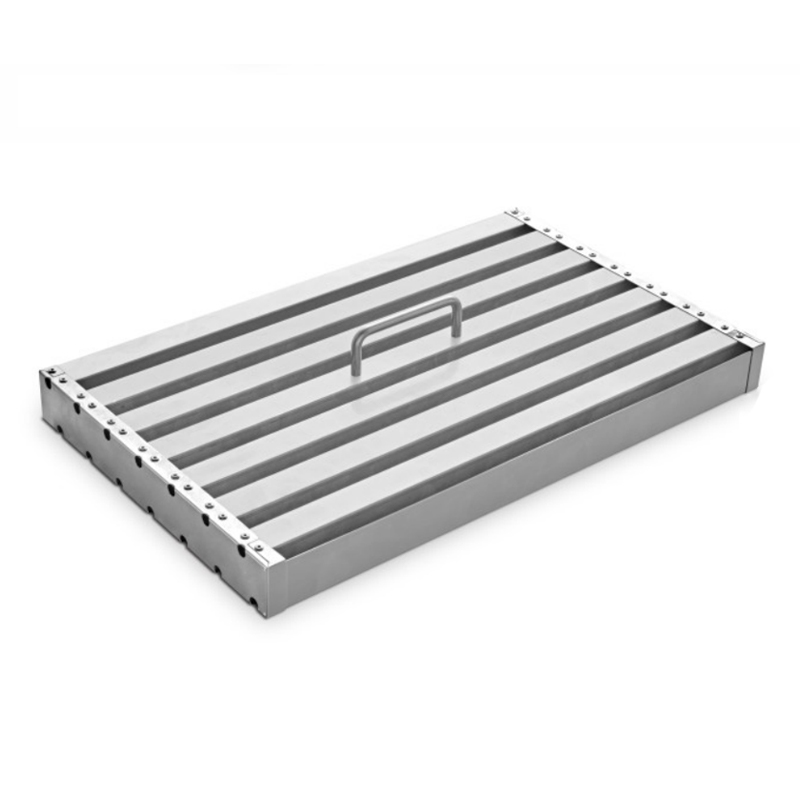
What Handle Construction Makes Grease Filters Easier to Clean?
Handle design influences more than removal.
Commercial grease filters are often exposed to oily deposits, harsh cleaning solutions, moisture and frequent contact. The area surrounding the handle of a grease filter is often very difficult to clean. Small joints, poor welds and excessive recesses can all hinder cleaning of these areas.
Simple and accessible constructions are generally easier to maintain than constructions consisting of many overlapping parts.
Examine the Handle Attachment
Two filters can look like they have the same handles but they are attached differently.
A welded handle does not need any additional fastening hardware. The quality of the weld and the surface finish are however important.
A mechanically fastened handle may be required for a design but it is wise to investigate whether the fasteners create uncleanable crevices and whether they may loosen over time with use.
Determine the actual load on the attachment during removal.
A handle that looks adequate to carry the canister may not be properly connected to the filter frame.
Check for Sharp Edges and Cleaning Traps
Maintenance staff need to grip the handle of tools repeatedly. Sometimes they are wearing wet gloves.
Rough edges, protruding fasteners and poor weld end finishes create problems for handling and cleaning.
Useful inspection points include:
Smooth accessible gripping surfaces
No exposed sharp edges
Secure handle attachment
Accessible joints for washing
No unnecessary narrow grease-trapping gaps
No visible cracks at attachment points
The cleaning method should also be considered.
If washed in commercial cleaning equipment then the handle must not get in the way of the filter washing being carried out on racks etc.
A design should be tested with the same cleaning processes as specified by the kitchen operator, not assuming that all handle solutions are equally convenient.
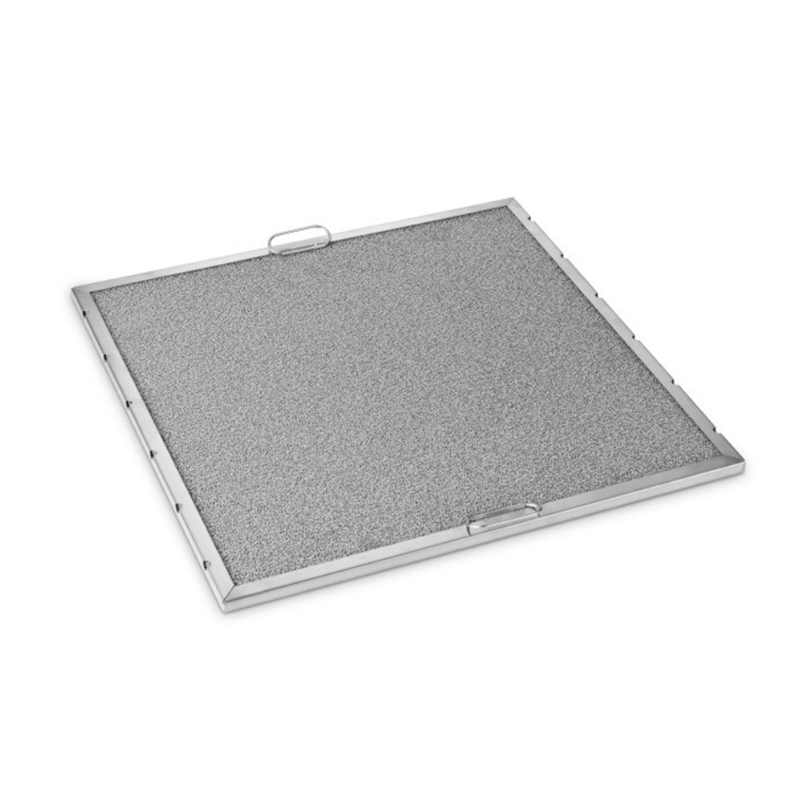
How Can Buyers Test Handle Accessibility Before Ordering Replacement Filters?
Passing dimensional inspection does not mean that a sample is ready for production.
Physical handling tests can be particularly valuable for a grease filter handle. Problems with the handle can occur after the product has been installed.
Test the Handle in the Actual Hood
Start with hood closed and filter cool enough to handle under site maintenance procedure.
Install the sample in the setup as you would have neighboring filters installed.
Have the maintenance operator remove and reinstall it according to normal procedures.
Can the operator reach the handle in a comfortable position, control the filter and clear the retaining track without having to force the frame?
Notice how the filter moves during the first and last stages of this filter change.
Repeat the Test After Cleaning
A clean, dry grip feels differently to a wet grip held with gloved hands.
After washing and drying of the test sample by the cleaning method under investigation, check the sample attachment and repeat the test for handling.
Inspect for looseness, damage to the handle connection, or any change in the fit.
There is no ‘magical’ number of cleaning cycles which can guarantee a handle will last for a certain period of time. It is up to the OEM buyer to agree a relevant test with the handle supplier.
Practical Sample Approval Checklist
Handle accessible after installation
Adequate grip space for the intended operator
No interference with neighboring filters
Filter can be removed without excessive twisting
Handle attachment remains secure
No sharp edges or uncomfortable gripping points
Handle area can be cleaned effectively
No damage after the agreed cleaning test
Reinstallation remains straightforward
A failed handling test is a design issue even though the filter itself may fit inside the hood.
What Handle Specifications Should OEM Buyers Confirm with Grease Filter Suppliers?
The handle should be included in the drawing instead of only being described as an accessory in the text.
For OEM or bulk replacement orders the supplier needs enough information to reproduce the approved design.
|
Specification |
What buyers should confirm |
|---|---|
|
Handle quantity |
Single or double |
|
Handle position |
Distance from reference edges |
|
Grip dimensions |
Width, depth, and usable finger clearance |
|
Handle projection |
Clearance from hood and adjacent filters |
|
Attachment method |
Welded or mechanically fastened |
|
Материал |
Material used for the handle and attachment |
|
Surface finish |
Smoothness and cleaning accessibility |
|
Intended handling load |
Conditions the handle connection must withstand |
|
Installation orientation |
Correct direction inside the hood |
When ordering, it is also wise to ask how the supplier checks for handle placement and consistency of attachment during production.
For markets requiring grease-filter listings or fire-safety features, verify that the complete filter, including any handle modifications, meets the requirements for the market and that a handle modification does not adversely affect existing product approvals.
For larger orders, we would like to request one finished sample of the proposed handle design for your approval. Please also test installation, removal and cleaning and inform us about the results before we can approve production.
These steps are especially important to consider when ordering replacement filters for a currently installed hood that cannot be re-configured by the operator.
Looking for Grease Filters That Match Your Maintenance Requirements?
A comparison of replacement filters for commercial kitchens will typically start by comparing dimensions and materials. The position and ease of removal of handles is also important. Foshan Simple Technology Co., Ltd. supplies commercial kitchen grease filters, many of which are equipped with different handle settings for ventilation equipment in foodservice applications. Comparison of standard and OEM filter frames, handle position, materials, attachments, etc. and the conditions under which the filter will be cleaned, all need to be clearly defined by the buyer. An existing sample or detailed drawing is required to clearly outline the needs of the filter that is required to fit into a particular hood and is to be easily cleaned and serviced on a regular basis.
Вывод
A commercial grease filter handle should allow for controlled removal, easy cleaning and reliable reattachment to the hood. Single or double handles can be the right choice depending on filter size, available space for removal, filter attachment and the maintenance conditions. For OEM applications the position of the handle and the grip clearance should be specified on the drawing. A test of a sample filter in the hood is the final handling test and can reveal problems not caught in normal dimensional checks.
Часто задаваемые вопросы
1. Are double-handle grease filters easier to remove than single-handle filters?
While a second grip point can be useful, to improve control, double handles can be undesirable. While pleasant to use, the value of double handles depends upon filter weight, handle position, hood height and removal method.
2. What is the most important factor in grease filter handle placement?
The handle of the filter must remain accessible during removal and reinstallation of the filter. Please check for finger clearance, for freedom of movement of the retaining track, for correct installation position and possible interference with adjacent filters.
3. Are welded grease filter handles better for cleaning?
The welded handle does not require separate fastening hardware but depends on the quality of the weld, the surface finish, the geometry of the weld joint and the degree of accessibility for cleaning purposes. Even poor welds do not necessarily mean impossible to clean.
4. Can I change the handle design on an existing commercial grease filter?
Possibly, but the change must be evaluated for fit, attachment strength, cleaning access, and any applicable product approval. A modified handle should not interfere with the hood installation or filter retention.
5. What should OEM buyers provide when ordering custom grease filter handles?
Details required for new handle: Filter size, mounting position, number of handles, mounting position of handles, required grip width, method of attachment, material, cleaning conditions. A drawing or sample for approval would also be helpful.
