


5 Tage in der Woche von 8:30 bis 17:30 Uhr

Food-Contact Safety of Stainless Steel Kitchen Accessories: Materials, Standards, and Compliance
Food-contact safety depends on the finished accessory, its intended use, and the requirements of the destination market. A stainless steel grade identifies an alloy family or composition specification; it does not, by itself, establish that a welded, coated, or assembled kitchen accessory is compliant for every food and operating condition.
Buyers should define the contact conditions, specify the complete construction, and obtain evidence that covers the actual article. Keep legal requirements, voluntary standards, and customer specifications distinct. Each can affect acceptance, but they do not provide interchangeable forms of approval.
Identify the food contact surfaces first
A fryer basket directly contacts food and cooking oil. An equipment foot normally serves a structural role outside the food-contact zone. A light installed above a cookline has a different exposure and safety function again. Classify the surfaces in the finished installation rather than assigning one requirement to every stainless component.
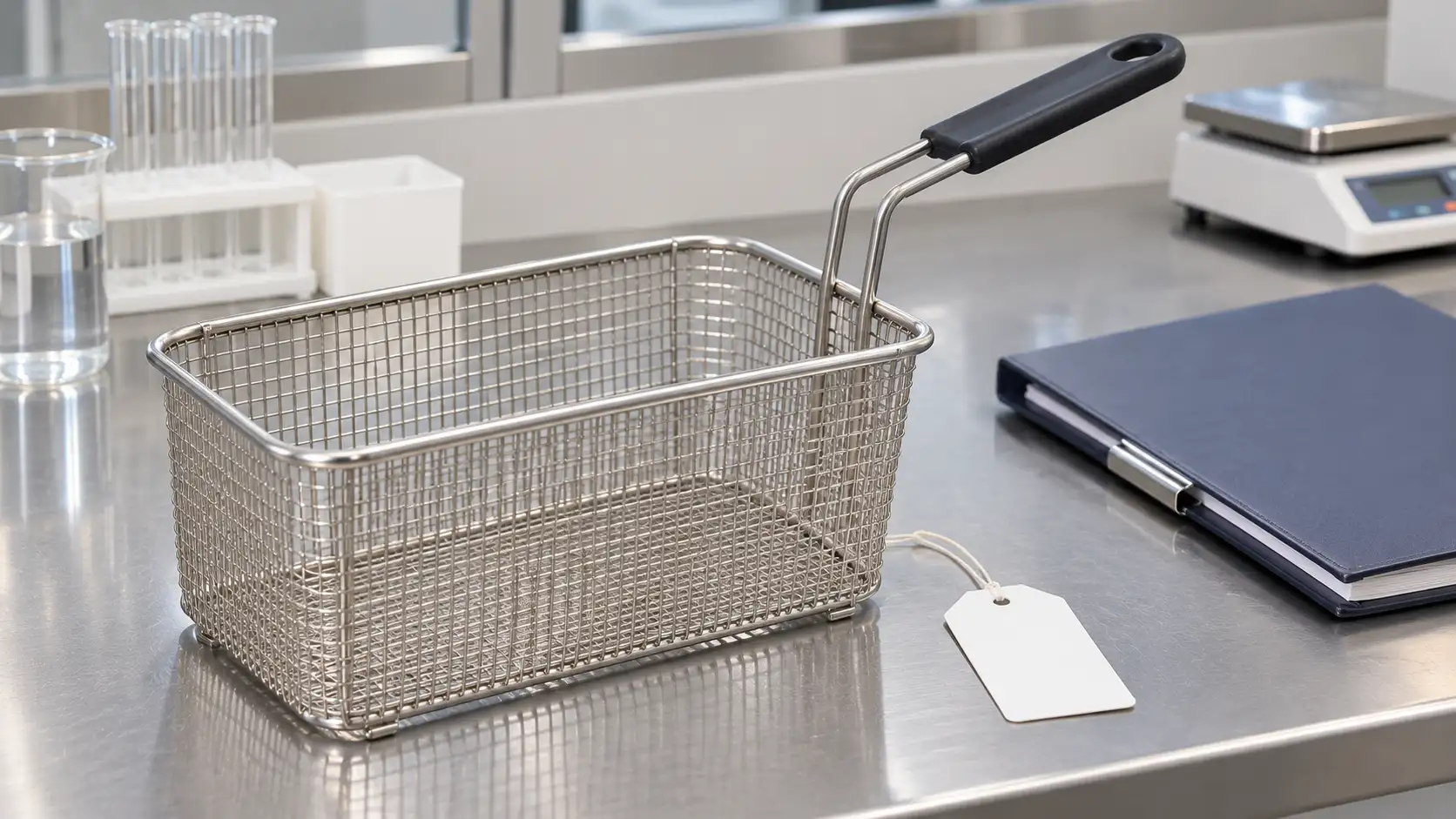
For commercial fryer baskets, map the mesh, rim, welds, hooks, and any part of the handle that can reasonably contact food. Consider normal use and foreseeable contact during loading, draining, cleaning, and storage. This map helps determine which materials and processes require assessment.
Document the foods involved, contact duration, operating temperatures, repeated-use conditions, and cleaning chemicals. A component used briefly with dry food presents different questions from one exposed repeatedly to hot oil or acidic ingredients. Let these conditions guide the compliance review and testing scope.
Specify the alloy without treating it as a certificate
Common grade labels such as 304 and 316 can be useful starting points, but the chosen grade still needs to suit the exposure. Select the alloy with appropriate technical input where corrosion, aggressive cleaning, or demanding contact conditions are involved. Avoid promising that one grade is universally safe or another is automatically unsuitable.
Write the material designation and applicable material specification into the order. Establish what documentation will connect the incoming material to the supplied lot. If identity testing is required, agree a method capable of resolving the relevant question and its limitations.
An attraction-to-a-magnet check cannot provide a complete alloy identification or a food-contact assessment. Likewise, a composition report alone does not establish the suitability of the finished surface. Treat material identity and finished-article performance as related but separate evidence.
Include welds finishes and other materials
Review the complete bill of materials. Welding consumables, plated areas, coatings, handle grips, adhesives, and other components may introduce requirements beyond those for the base steel. A stainless body should not cause these materials to disappear from the assessment.
Inspect food-contact surfaces for defects that affect cleaning and use. Rough joints, cracks, trapped residues, and inaccessible crevices deserve attention. Specify acceptance criteria and appropriate manufacturing controls rather than relying on a bright finish as evidence of hygiene.
For a wire-wound stainless steel fryer basket, confirm the ordered material and surface treatment explicitly. Similar model descriptions may cover different constructions. Ask the supplier to resolve inconsistent material descriptions before the sample or report becomes the approval reference.
Cleaning instructions also belong in the specification. Establish which chemicals and methods are permitted and what inspection or replacement is necessary after damage. A suitable original surface can be compromised by an unsuitable cleaning process or an unapproved repair.
Understand the European Union framework
Regulation (EC) No 1935/2004 establishes general EU requirements for food-contact materials and articles. Under normal or foreseeable use, constituents must not transfer to food in amounts that endanger health or cause unacceptable changes to food composition or sensory properties. Traceability and supporting compliance documentation are also part of the framework.
Regulation (EC) No 2023/2006 addresses good manufacturing practice. The manufacturing system should control the processes and starting materials needed to maintain conformity. A favorable test on one sample cannot compensate for uncontrolled changes in later production.
The EU does not provide one fully harmonized, material-specific regime for every food-contact material. For metal accessories, check applicable national provisions in the destination Member State as well as the general framework. Ask the responsible compliance specialist or laboratory to identify the current requirements for the intended market.
Do not automatically apply the plastics rules in Regulation (EU) No 10/2011 to a bare stainless steel article. Where an accessory contains plastic parts, assess the relevant components and their use separately. The applicable rules and any required declarations depend on the material, construction, and market.
Separate United States guidance from product approval
The FDA Food Code is a model offered for adoption by jurisdictions. Its existence does not mean that every jurisdiction has adopted the same edition or every provision. Verify the rules applicable where the finished equipment will be used.
Use the applicable adopted code and equipment requirements to establish material and cleanability criteria. Ask the responsible reviewer to identify the relevant provisions for the accessory and installation. Keep that review connected to the actual surface construction instead of reducing the decision to a familiar alloy designation.
Avoid using FDA approved as a blanket description of a stainless kitchen accessory without identifying an actual applicable authorization or basis. A Food Code reference, a laboratory result, and a product certification are different things. The purchasing file should state what each document demonstrates.
If an NSF/ANSI standard or certification is specified by a customer or authority, confirm the relevant standard, product scope, and current listing. Do not infer certification from a supplier logo, an unrelated certificate, or a material description. Check that the ordered model and construction are covered.
Ask for a report that matches the intended use
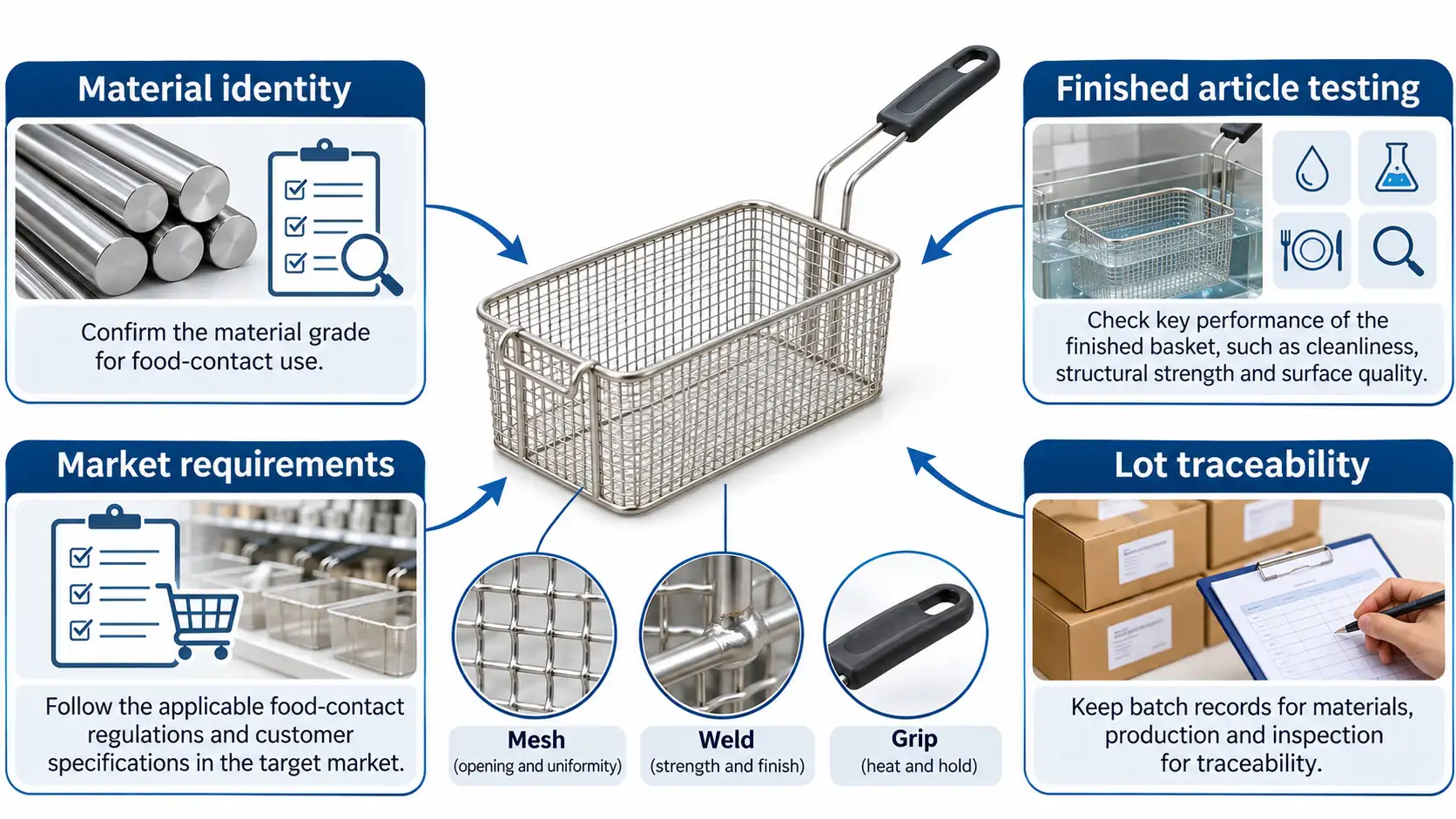
Give the laboratory the contact map, material construction, surface treatments, food types, time and temperature conditions, and destination markets. Ask it to propose the applicable assessment and test conditions. Avoid selecting a test simply because a previous supplier used it.
|
Evidence |
What it can help establish |
Important limitation |
|
Material documentation |
Identity of the specified starting material |
Must connect to the supplied lot |
|
Finished article test report |
Results under identified test conditions |
Does not cover every use automatically |
|
Compliance statement |
Declared scope and regulatory basis |
Needs supporting evidence |
|
Certification listing |
Coverage under a named certification scheme |
Check model and construction scope |
|
Manufacturing records |
Traceability and controlled production |
Must reflect the actual goods |
Check the sample identity, report date, laboratory, methods, acceptance basis, results, and any restrictions. Ensure the report represents the production construction, including surface treatment. A report on raw sheet metal may not answer questions introduced by welding or plating.
Agree report ownership and access before placing the order. The importer or other responsible business may need evidence that can be supplied to a customer or authority within the applicable process. A supplier saying that a test exists is less useful than a legible report with a defined sample and assessment basis. Protect confidential formulation or process details through an appropriate arrangement while ensuring the responsible parties can obtain the evidence they need.
Keep hygiene performance and chemical suitability visible as separate review items. An article can be easy to wipe while still having an unresolved material question, or have a suitable alloy while containing a joint that is difficult to clean. Review both before release. Where the assessment identifies limits on food type, temperature, duration, or cleaning, carry those restrictions into the approved instructions and customer specification so the purchasing decision remains valid in use.
Maintain conformity after approval
Agree which changes require review before production continues. Examples include a different alloy source, coating, welding consumable, finishing process, handle material, or manufacturing site. The compliance owner should determine whether revised documentation, additional tests, or customer approval is needed.
Keep lot references through packing and delivery. If a concern appears later, traceability should support identifying affected goods and the evidence used for their release. Store current instructions and reports with the approved drawing revision rather than in an unstructured email archive.
For a Simple project, share the food-contact application and documentation requirements with the accessory drawing, destination market, and operating conditions. Request a construction proposal and supporting evidence for review before approving bulk production. The final compliance decision should follow the applicable market requirements and product-specific assessment.
FAQ (häufig gestellte Fragen)
Is 304 stainless steel automatically food safe
No. Grade identity is only part of the assessment. Finished construction, contact conditions, cleaning, and applicable market requirements also matter.
Is 316 required for every kitchen accessory
No. Select the material for the actual exposure and requirements. A higher-numbered grade label does not replace an application review.
Can a raw material certificate replace finished article testing
Only where the assessment justifies relying on it for the question involved. Manufacturing and additional materials may require further evidence.
Does one test report cover all export markets
Not automatically. Check the report scope, intended use, legal basis, and destination requirements before relying on it.
Do equipment feet need the same food contact evidence as baskets
Not simply because both contain stainless steel. Classify their actual contact and installation roles, then assess the applicable requirements.
