


5 giorni alla settimana dalle 8:30 alle 17:30

How Should Commercial Grease Filters Be Packed to Prevent Frame Damage in Bulk Shipments?
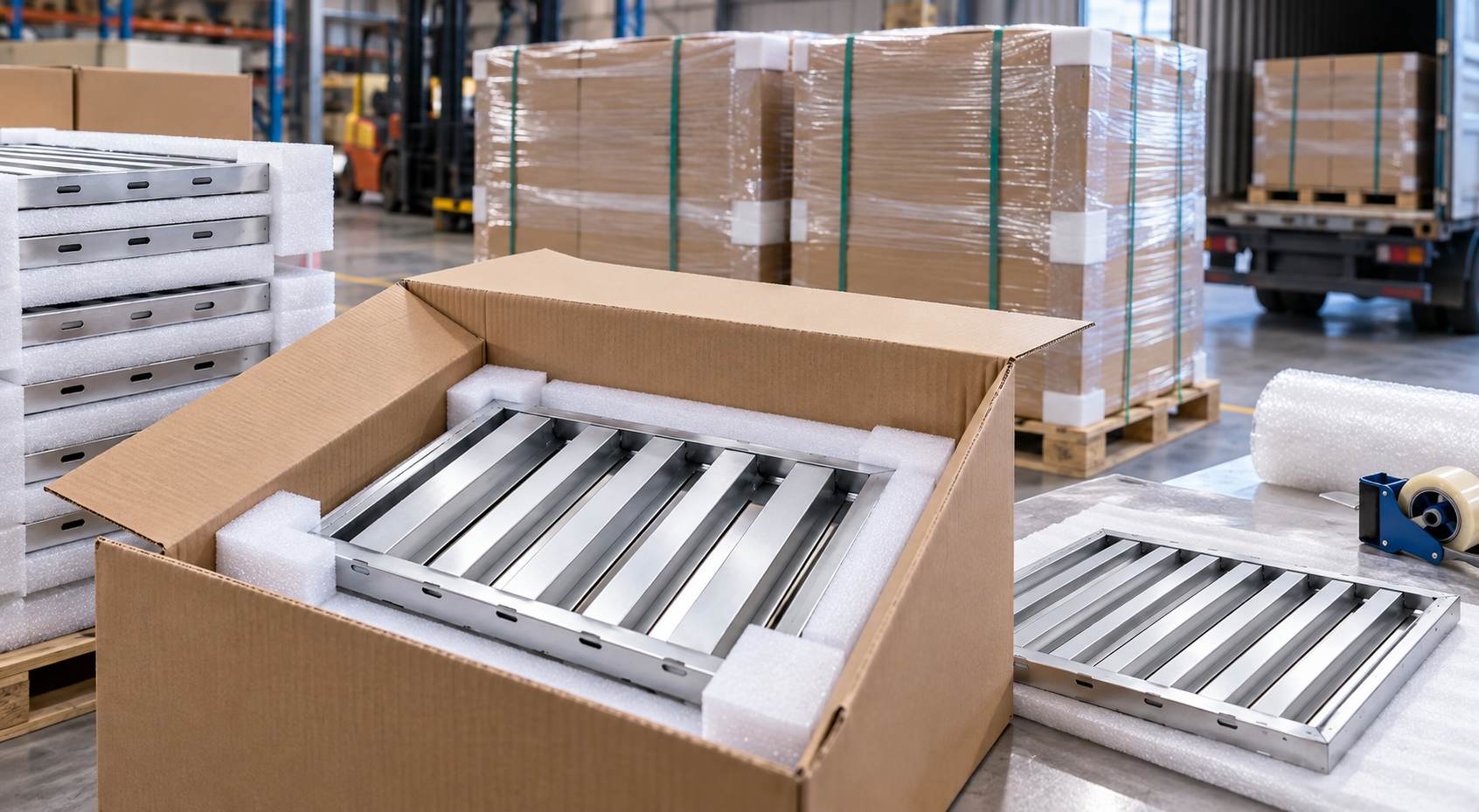
Commercial grease filters can leave a factory within specification and still arrive unusable if their frames, corners, handles, or baffle assemblies are distorted during transport. For importers, kitchen contractors, distributors, and replacement-parts buyers, packaging is therefore part of product quality rather than a separate logistics detail. The risk increases when several filter sizes share one shipment or when rectangular frames are stacked under uneven pressure. A useful packaging specification starts with the geometry of the filter, identifies which areas cannot carry compression, defines how individual units are separated, and gives the receiving team clear criteria for distinguishing transit damage from manufacturing defects.
Why Are Grease Filter Frames Vulnerable During Bulk Logistics?
A commercial grease filter is designed to sit accurately inside a hood track, so relatively small changes in frame geometry can matter after delivery. A corner pushed inward, a bowed side rail, or a bent handle may prevent easy installation even though the filter material itself is undamaged.
Buyers selecting from a commercial grease filter category should therefore consider transportation geometry at the same time as material and dimensions.
Where Does Shipping Pressure Usually Become a Problem?
Rectangular frames can be affected when loads are concentrated at corners or when cartons are stacked so that pressure passes through unsupported areas. Protruding handles are another concern because they can press into the next filter or the carton wall.
Internal baffles should not be treated as convenient load-bearing spacers. Their job is part of the filter’s airflow and grease-separation structure, so packaging should avoid transferring compressive forces through them.
The buyer does not need to prescribe a universal packaging material or carton thickness. What matters is defining the outcome: the filter must retain the approved frame geometry and arrive without handle deformation, loose internal parts, deep dents, or surface damage beyond the agreed appearance standard.
Which Product Features Should Be Mapped Before Packaging Is Designed?
Packaging should be based on the exact filter drawing rather than a generic carton used for several different models. The supplier needs to know which dimensions control installation and which features project beyond the main frame.
A packaging review can begin with the same dimensional information used for the product itself.
Which Areas Need Physical Clearance?
Record the outside width, height, depth, handle projection, frame corners, and any protruding fixing or drainage features. If the filter has different front and rear profiles, packaging orientation should be defined so units are not stacked face-to-face in a way that creates point loads.
For mixed-size orders, carton labels should identify the filter reference clearly. Similar-looking filters can be difficult to distinguish once removed from packaging, especially when the differences are only in one dimension.
Il commercial kitchen component catalog shows that several filter constructions and sizes can exist within one product family, which is exactly why packaging records should use part references rather than descriptions such as “large hood filter.”
How Should Buyers Think About Stack Direction?
The safest stack direction depends on the filter geometry and the internal support arrangement. Buyers should ask the supplier to show how the filter is supported inside the carton and where vertical load will travel when cartons are stacked.
A sample pack can then be opened and checked for pressure marks. If the same corners, handles, or frame rails show contact on every unit, the packaging may be transferring load through the wrong area.
How Should Inner Protection and Cartons Be Specified Without Distorting the Filter?
Packaging has to restrain movement without squeezing the filter into a new shape. That balance is more useful than simply asking for “stronger cartons.”
A rigid outer carton can still allow damage if the filter slides inside it, while excessive internal compression can distort a thin rectangular frame before shipment even begins.
What Should Individual Separation Achieve?
Adjacent filters should not rub directly against exposed handles, sharp frame corners, or finished surfaces during normal transport. Separators, sleeves, pads, or other protective materials can be selected by the supplier, but the buyer should define which product areas need separation.
The chosen material should also be appropriate for the shipment and destination. Packaging that absorbs moisture, collapses easily, or leaves residue on the finished filter may create a new problem while solving another.
Rather than dictating a packaging material without testing it, approve a complete packed sample.
Why Is Carton Fit More Important Than Empty Space?
Too much empty space allows repeated movement. Too little space may create constant compression. The finished carton should hold the filters in a controlled position while avoiding pressure that changes frame geometry.
A procurement specification can record carton quantity, product orientation, separator arrangement, labeling, and whether corner or handle protection is required. Exact carton construction should be based on the approved shipment configuration.
For broader manufacturing context, buyers can review the company’s product strength information, while the packaging acceptance itself should remain specific to the ordered filter and shipment method.
What Should Buyers Check During Packaging Sample Approval?
Packaging approval should involve both a packed carton and the filters removed from it. Looking only at the outside of the carton does not reveal whether pressure is being transferred into the product.
The buyer should document the condition before packing, inspect the packed arrangement, and then examine the filter again after the agreed handling simulation or shipment sample.
Which Product Checks Matter Most After Unpacking?
Measure the critical outside dimensions again and place the filter on a flat reference surface to look for obvious twist or bow. Inspect the corners, handles, frame rails, baffle positions, and surface finish. A sample should still enter the intended hood track where fit is critical.
A useful packaging-approval checklist can include:
-
Correct product reference on the carton
-
Individual filters separated where contact could cause damage
-
Handles do not carry stacking pressure
-
Frame corners have adequate clearance or protection
-
Product cannot move freely inside the carton
-
Internal baffles are not used as compression supports
-
Finished surfaces show no unacceptable abrasion
-
Outside dimensions remain consistent after unpacking
-
Frame sits without obvious twist
-
Mixed sizes are labeled and segregated clearly
The checklist should be adapted to the shipment rather than treated as a universal packaging standard.
How Can Shipping and Receiving Records Reduce Disputes?
Even well-designed packaging cannot eliminate every logistics event, so buyers also need records that show product condition at the point of shipment and at receiving.
A clear record makes it easier to identify whether a problem is isolated, repeated across a carton, or linked to a particular part reference.
What Should Be Recorded Before Shipment?
Useful records include carton quantity, filter quantity per carton, packing orientation, label format, photos of the packed layers, and photographs of representative finished filters before the cartons are closed.
If different sizes are shipped together, the packing list should connect each part number with its carton identification. This reduces the chance that receiving teams open and redistribute cartons before damage or quantity discrepancies are documented.
What Should Receiving Teams Inspect First?
Inspect the outside cartons for crushing, punctures, water exposure, or other obvious handling damage before unpacking. Then check a defined sample of filters for bent corners, bowed rails, damaged handles, displaced internal parts, and surface abrasion.
Where installation fit is critical, compare selected units against the approved dimensions rather than relying on appearance.
Receiving teams should photograph damage before attempting to straighten a frame. Once a filter has been manually corrected, it becomes much harder to determine whether the problem came from production, transport, or field handling.
Professional Technical Support from Foshan Simple Technology Co., Ltd.
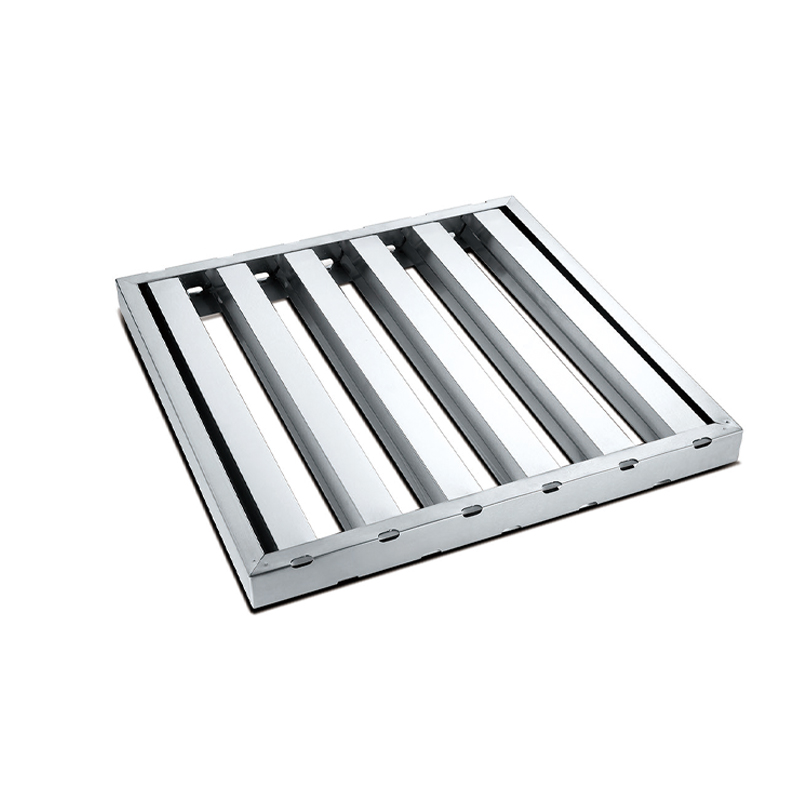
Foshan semplice tecnologia Co., Ltd. manufactures commercial kitchen components including grease filters, and its website lists several stainless-steel baffle constructions for different hood requirements. The BH223 stainless steel industrial grease baffle filter is described with a stainless-steel frame and Z-shaped plate structure for kitchen exhaust applications. For bulk purchasing, product approval and packaging approval should be treated as two connected stages: the filter drawing establishes the geometry that must be preserved, while the packed sample confirms that corners, handles, frame rails, and internal elements remain protected during the agreed shipment configuration.
Conclusione
Grease filter packaging should protect geometry, not merely keep the product inside a carton. Buyers need to identify vulnerable corners, handles, frame rails, and internal structures, then approve how each filter is separated, supported, labeled, and restrained. A packed sample should be inspected after handling, with critical dimensions and frame condition checked again before the packaging method is released for production. Clear pre-shipment photos and receiving records then provide the final control needed to distinguish manufacturing variation from logistics damage.
Domande frequenti
1. Why can a grease filter be unusable even when only one corner is bent?
The frame must fit the hood track accurately. A distorted corner can change overall squareness, create installation resistance, leave gaps between filters, or prevent the unit from seating correctly even when the baffles remain intact.
2. Should grease filters be packed tightly to stop movement?
They should be restrained, but excessive compression can also distort the frame. The packaging should prevent free movement while keeping stacking and side pressure away from vulnerable rails, handles, corners, and internal structures.
3. Is a stronger outer carton enough to prevent filter damage?
Not necessarily. A strong carton cannot compensate for poor internal support. Damage can still occur if filters move inside the box, handles contact neighboring units, or stacking pressure passes through unsupported areas.
4. What should buyers inspect immediately after receiving bulk grease filters?
Check carton condition first, then inspect frame corners, side rails, handles, internal components, surface finish, and critical dimensions. Photograph damage before straightening or installing the affected filter.
5. Should mixed filter sizes be packed in the same shipment?
They can be, but each size should have clear part identification and a packing arrangement designed for its geometry. Mixing similar-looking filters without controlled labeling increases receiving and installation errors.
