


5 dias por semana das 8:30 às 17:30

How to Prevent Shipping Damage to Commercial Fryer Baskets in Bulk Orders
Prevent shipping damage to commercial fryer baskets by controlling movement inside each carton, protecting handles and rims, limiting nesting pressure, and validating the complete shipping pack before the bulk order leaves the factory. Stronger cartons help only when the baskets inside have a reliable support and restraint arrangement.
The packaging specification should be approved with the basket drawing. Body dimensions alone leave important risks unanswered: a projecting handle can receive an impact, tightly nested rims can jam, and loose baskets can rub during transport. Plan for the actual route, order quantity, and receiving process.
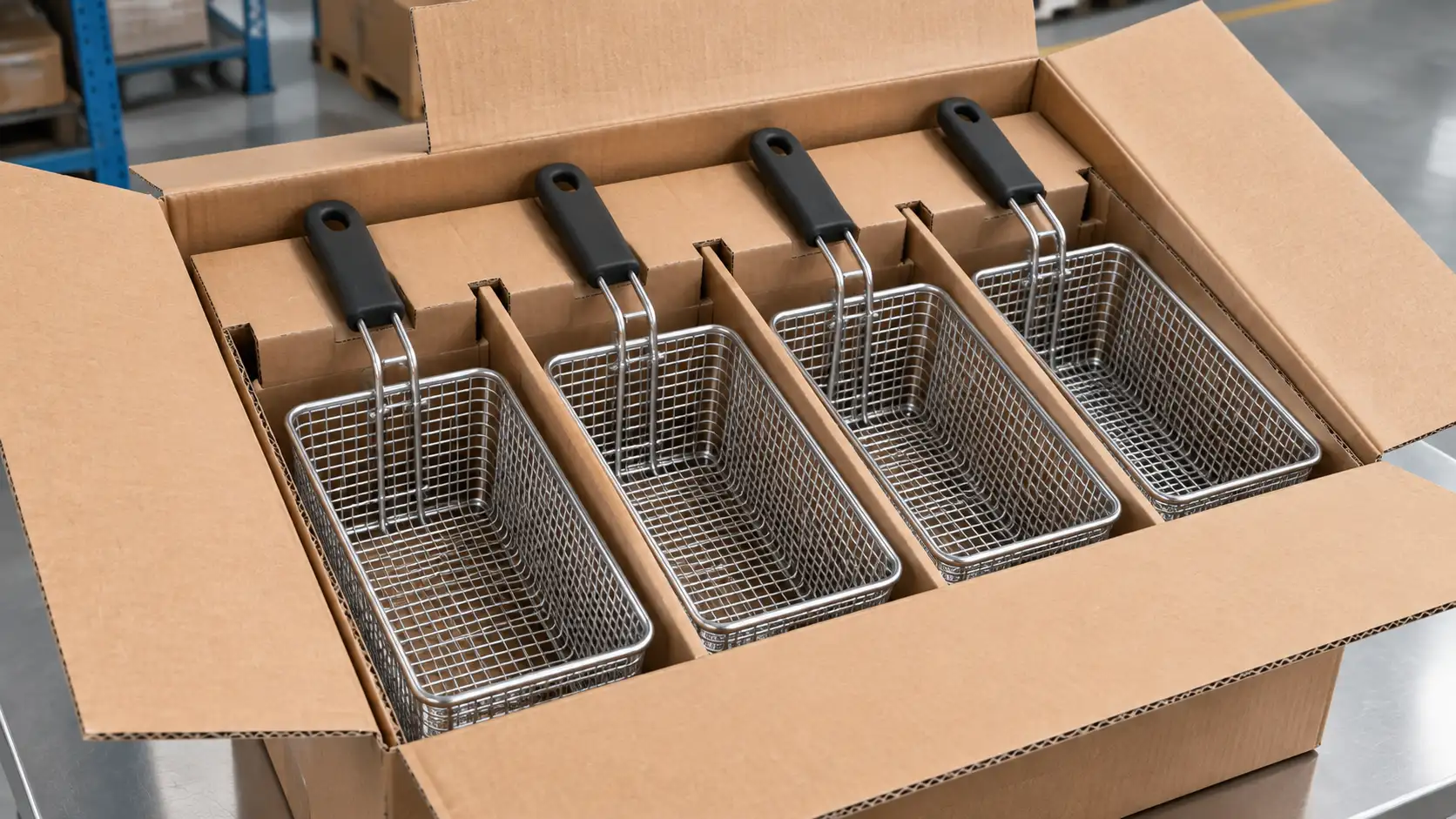
Identify the vulnerable parts first
Start with the basket’s geometry. Handles, hooks, top rims, corners, and exposed wire ends need particular attention. A distorted basket can look acceptable in a carton yet sit incorrectly in the fryer or fail to hang in its intended position.
Comércio cestas de fritura vary in shape and handle arrangement. A packing method approved for one model should not automatically be used for another. Long handles, double handles, and large rectangular bodies create different contact points inside a package.
Make a simple damage map using a production sample. Mark places that touch neighboring baskets, the carton, and internal supports. Identify which surfaces may carry packing loads and which must remain clear. The supplier should confirm those assumptions against the product design.
Set acceptance criteria before shipment. Agree the permitted dimensional variation, handle alignment, rim condition, weld condition, surface condition, and functional fit. Include a representative fryer or an approved checking fixture when fit is critical. A photograph of an undamaged sample cannot replace measurable requirements.
Control nesting depth and separation
Nesting saves shipping space, but excessive insertion can transfer pressure through rims and mesh. Baskets that fit neatly together at the packing station may become difficult to separate after movement and stacking loads. Determine the nesting limit through sample trials.
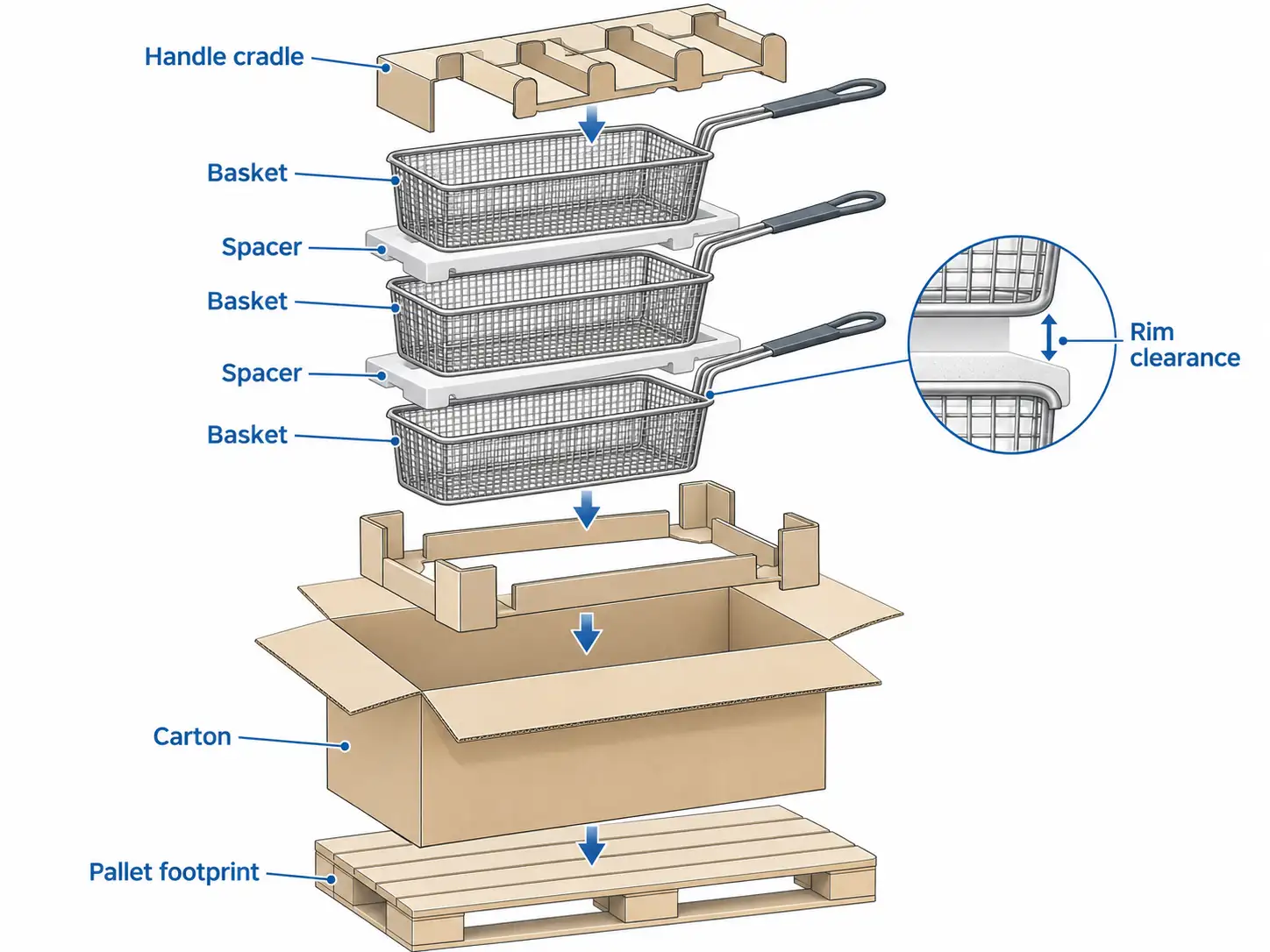
Use suitable separators or spacers to maintain the approved clearance. Their purpose is to stop damaging contact and uncontrolled movement. They must remain in place during handling and must not leave debris, residue, or difficult-to-remove material on surfaces intended for food use.
Check unpacking as part of the trial. Receiving staff should be able to remove baskets without pulling hard on handles or forcing tools between rims. If separation damages the product, the pack has failed even when the outer carton remains intact.
Avoid setting carton quantity from freight cost alone. Adding more pieces changes gross weight, internal forces, and handling difficulty. Compare several realistic pack counts, then approve the one that protects the product and works for warehouse staff.
Protect handles without creating another stress point
Keep projecting handles clear of the carton wall and prevent them from carrying unintended stacking loads. A fitted support or compartment may help, provided its contact points have been reviewed. Packing pressure should not be concentrated on a small weld or a thin section of wire.
Do not force handles into a convenient orientation to reduce carton size. If a removable or folding handle is part of the approved design, follow its assembly and packing instructions. A permanently fixed handle should be packaged in its intended geometry.
|
Potential damage |
Likely packaging concern |
Design response to evaluate |
|
Bent handle |
Projection exposed to impact |
Clearance and supported restraint |
|
Distorted rim |
Excessive nesting or top pressure |
Nesting stops and revised load path |
|
Scuffed wire surfaces |
Repeated contact during movement |
Separation and movement control |
|
Basket trapped in another |
Insufficient nesting clearance |
Spacers and unpacking trial |
|
Damaged lower cartons |
Stack or pallet arrangement unsuitable |
Carton strength and pallet trial |
The responses are proposals to validate. No universal foam thickness, separator size, or carton grade can be selected without the basket and shipping conditions.
Specify the complete carton system
Document the basket orientation, pieces per carton, separator layout, handle supports, closure method, and finished gross weight. Add photographs or a packing diagram so a different shift can reproduce the arrangement. Identify the packaging revision on the production order.
Choose carton construction for the contents, handling route, stacking exposure, and expected environment. Discuss these conditions with the packaging supplier. A visually thicker carton is not enough evidence that the assembled pack will perform as required.
Keep loose accessories separate from mesh surfaces and ensure they cannot become hard impact points. If protective bags are used, confirm material cleanliness, removal, and disposal requirements. Pack baskets clean and dry, using materials suitable for the intended product contact and storage conditions.
For a wire-wound stainless steel fryer basket, review rim and handle clearances using the actual production sample. A nominal body size does not define the envelope needed by protective supports, separators, and projecting features.
Include mixed orders in the plan. Similar-looking models should have distinct labels and packing lists. Mixing different shapes inside one carton can defeat a separator arrangement developed for identical baskets and complicate inspection when a problem is found.
Make pallet and container loading part of the design
A sound individual carton can still be damaged by an unsuitable pallet arrangement. Review pallet dimensions, carton orientation, stacking height, load stability, and protection from straps or stretch wrap. Keep the unit load within the approved pallet footprint.
Straps should not crush carton edges or transmit concentrated forces into handles. Evaluate edge protection and restraint with the actual unit load. Excessive wrapping tension can also distort a weak pack; adding more wrap is not automatically an improvement.
Agree how cartons will be protected from heavy or incompatible cargo in a mixed shipment. Specify any stacking restrictions and make them visible to the party arranging transport. Confirm what handling equipment and unloading space are available at the destination.
For sea freight, discuss moisture exposure and storage conditions with the packaging and logistics providers. Do not assume a sealed bag or an arbitrary quantity of desiccant solves condensation risks. The chosen protection needs to suit the route, materials, and storage period.
Test the production pack before releasing the order
Validate a representative packed sample, including production baskets, separators, closure, labels, and pallet arrangement where relevant. Agree the distribution route and failure criteria with a packaging laboratory or qualified packaging engineer before selecting a test procedure.
ISTA procedures address different distribution conditions. A parcel test should not automatically be used as proof for a palletized ocean shipment. The selected evaluation may need to address handling shocks, vibration, stacking, and environmental exposure appropriate to the actual route.
Inspect both the package and the baskets after the trial. Measure critical dimensions, check handle and rim alignment, look for broken or damaged joints, confirm surfaces meet the agreed condition, and test separation and fit. Record sample identity, packing revision, procedure, observations, and disposition.
A small pilot shipment can provide additional route-specific evidence. Track where any damage occurs and revise the pack before scaling. One successful shipment does not guarantee every future delivery, so keep production packing controls and receiving checks in place.
Keep an approved packed sample or a complete photographic sequence at the packing station. Inspection should confirm the hidden separators and handle supports before closure, since finished-carton checks cannot establish whether the internal arrangement matches the approved trial.
Inspect on receipt and close the feedback loop
Photograph the pallet and cartons before unpacking if damage is visible. Record carton identification, affected quantities, and the condition of internal supports. Follow the carrier’s and supplier’s documented reporting process and deadlines rather than assuming one universal claims window.
Separate affected stock for inspection. A bent handle or damaged joint should not be straightened and returned to food-service use without an approved disposition. Keep samples and packaging evidence until the investigation and claim requirements are resolved.
Compare damage location with the original damage map. Repeated handle damage may call for different restraint, while crushed lower cartons may require a revised stacking plan. Change the controlled packing specification so the next order benefits from the investigation.
Before placing a bulk order with Simple, discuss basket and packaging requirements using the model drawing, quantities, destination, transport method, and receiving constraints. Request a sample packing proposal for approval and route-appropriate validation before shipment.
FAQ
Is bubble wrap enough for bulk fryer baskets?
Not by itself. Protection must also control movement, nesting, handle clearance, carton loads, and handling conditions. Validate the complete pack.
How many baskets should fit in one carton?
Determine that through packing trials and route requirements. Basket geometry, gross weight, handling limits, and protection needs all affect the answer.
Can handles be detached to reduce shipping volume?
Only when the approved basket design permits removal and provides a suitable reassembly method. Do not modify fixed handles for packing convenience.
Do intact cartons prove the baskets are undamaged?
No. Internal movement and nesting pressure can damage contents without obvious external marks. Inspect critical dimensions and functional fit as agreed.
Should every reorder repeat the full packaging trial?
Use an agreed change-control plan. Reassess changes to basket geometry, packing materials, carton quantity, pallet arrangement, or route that could affect protection.
