


5 dias por semana das 8:30 às 17:30

Why Do Nested Fryer Baskets Jam During Unpacking? Taper, Handle Interference, and Clearance Checks
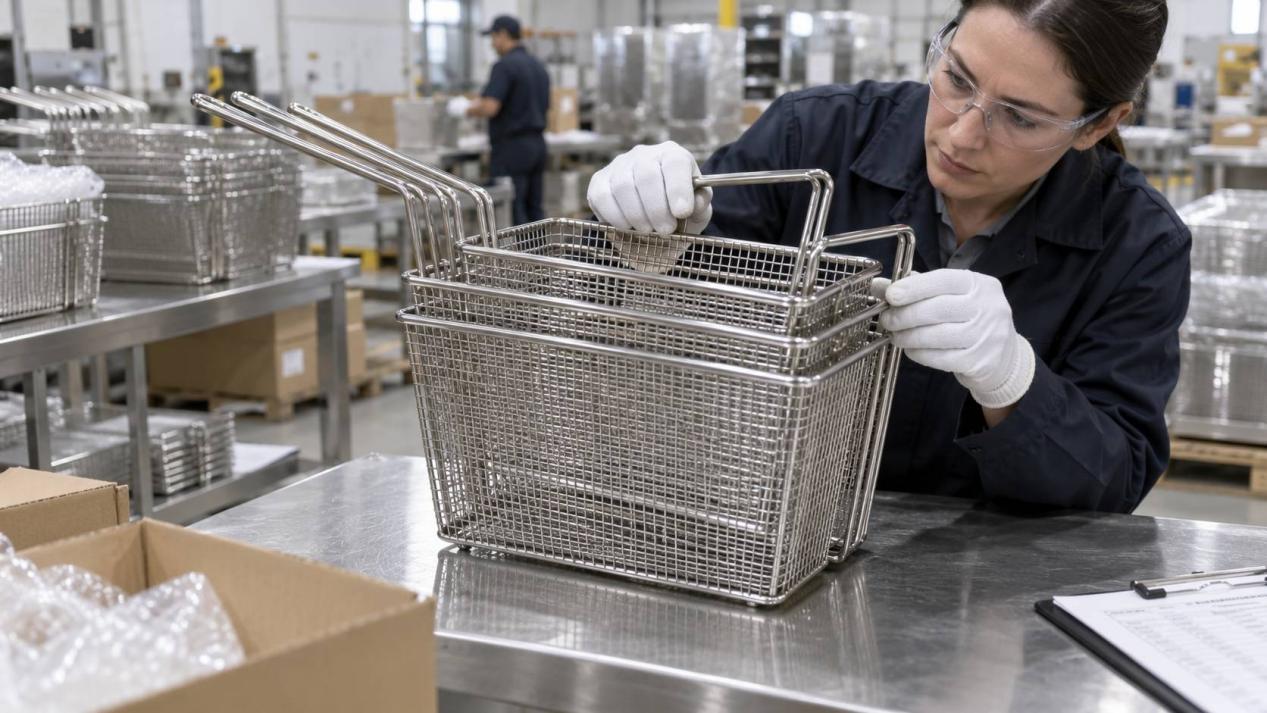
Two straight baskets can lock without either one being damaged in transit. Each additional basket bears on the pair below, driving the upper taper deeper. On another pair, a hook can pass through an open square of mesh during nesting and meet the wire beneath it when lifted. Pulling hard moves the baskets relative to one another; a fresh rub then records the pull as well as the jam.
The first movement is therefore worth seeing. Perhaps the whole rim rises. Perhaps only the left side opens. Perhaps the rim stays still while one handle bows. Receiving staff may call every version “baskets stuck together,” but the load is travelling through a different part in each one.
At Which Point Did the Lift Stop?
Make the first lift before changing the orientation found in the carton. Turning layers on a bench can release a hook or swap the loaded side before anybody has seen it.
Read the two rims before turning anything
Mark both upper rims with one short line; even a slight difference in rise will break the line on one side. Grasp the frame on opposite sides and raise it only until the line parts. If the left segment separates but the right stays aligned, follow the right wall downward through the mesh. A generous opening at the rim does not rule out a lower corner perched on a reinforcing wire.
A wire polished on one face suggests sliding contact. A sharp witness mark at a handle root suggests that the hardware has become a latch. Compressed separator material shows where the stacked weight was passing. If there is no rub to follow, watch which component starts moving ahead of the others. A deflecting handle with a stationary rim shows that the lifting force is passing through the handle.
Appliance clearance answers a different question. The replacement fryer basket fit-check process checks one basket against its fryer; here, both contacting parts are baskets from the carton.
How Far Did One Taper Enter the Next?
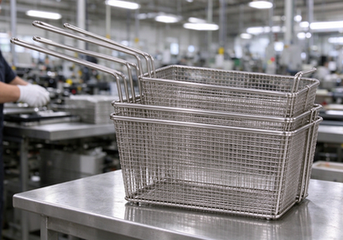
Taper saves carton space up to the intended resting depth. Past that point, the side wires begin doing a job that should have belonged to a stop.
What was supposed to carry the downward weight?
At the intended depth, weight should pass through a rim, cross member, or piece of packing placed as the stop. When that stop sits lower, entry continues until the tapered sides meet. More downward force then produces more squeeze at those sides. Every basket above adds to the load borne by the bottom pair.
Use identical upper and lower reference points to measure both sides of the jammed pair. Overall length and width miss this relationship. A lower wire that flares outward can touch early; a slightly narrow frame can sink farther and clamp over a longer area.
The usable depth has to come from this construction under its intended load. Where a separator sets that depth, a thinner separator is effectively a geometry change. It lets the basket travel farther even though no metal dimension has changed.
Did a Handle Root or Hook Become the Stop?
The main walls can remain visibly apart while the upward route is blocked by attached hardware.
Watch the hardware during the first lift
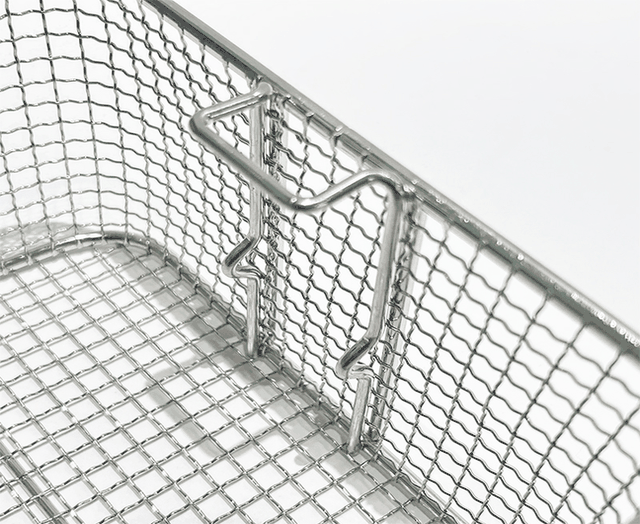
Crouch until your eye is level with the two rims. The grip of a folding handle can look flat from above even when its pivot has settled behind the lower rim. As the frame rises, that root strikes the rim’s underside. A drain hook can go down through an open mesh square, then catch the horizontal wire beneath that opening during the lift.
Fixed handles can alternate in a compact stack if they clear one another without help. When release begins only after a handle is pushed sideways, the real gap includes whatever flex that push creates. Wire stiffness and push direction vary, so the next worker may get a different result.
An overhead photograph captures the rotation of the baskets; a low side photograph captures roots and hooks. Together they define the packed orientation far better than “handles alternating.” Handle temperature and grip comfort remain separate product questions.
Will the Trial Recreate the Load Inside the Carton?
A loose pair on a table may open freely. The disputed contact appears only when the planned quantity, separators, dwell, and carton pressure act together.
Follow each pair as load comes off the stack
Identify the production-intent baskets and build the proposed stack. When the dwell ends, unload it in the same order used at receiving. If one pair hangs, pause before twisting and look again at the line and nearby hardware. Whichever side remains aligned points to the frame, hook, or separator that is still linking the pair.
Location within the stack narrows the cause. A jam only at the bottom follows accumulated load or excessive entry depth. A jam that follows one numbered basket follows that basket’s shape or hardware. A new bend found only after extraction may have been made during release; unchanged geometry with the same rub point keeps attention on the nesting interface.
Any release-force requirement should describe this taper, handle layout, and stack height. A value taken from another basket with a different taper and handle layout would not represent the force encountered when this carton is opened.
Could Another Packer Build the Same Arrangement?
Production needs an arrangement that is obvious from the first view into the carton. A phrase such as “nest carefully” leaves every important direction undecided.
Make the first view inside the carton unambiguous
Shoot the instruction image from where the packer normally stands. That single view should include the first handle’s direction, visible separator edges, and the number of baskets grouped together. If a sleeve keeps a hook above the mesh, leave a small part exposed; a packer can then spot an omitted sleeve before closing the carton.
Inspect one carton at receiving before separating the shipment into smaller lots. A bottom pair that alone refuses to rise points back to load and depth. Catches scattered among different handle roots point towards orientation or hardware variation. A frame already out of shape belongs on the path described in the fryer basket deformation guide rather than in a nesting-clearance adjustment.
Need a Repeatable Nesting Check for a Fryer Basket Order?
Foshan Simple Technology Co., Ltd. presents a four-layer basket e a stackable wire basket with reinforced base and dual hooks among its commercial-kitchen products. Those pages establish the available constructions, not a universal depth or release force for any way a customer might pack them.
For sample work, pair the basket drawing with the proposed carton arrangement. The condition to reproduce is defined by stack height and rotation, separator thickness, the points bearing the load, and the direction of lift. That is more useful than sending a separated pair with only the comment that it arrived tight.
Conclusão
Every jam has an interface. Tapered sides may be carrying the stacked weight, or a root or hook may be barring the upward route. Uneven rim movement and a witness mark show which explanation fits. Repeat the trial at the stack height where the catch occurred, and put the successful orientation in clear view for packing and receiving. A basket that fits its fryer correctly does not need a fit redesign because it caught another basket during transit.
FAQ
Are jammed nested fryer baskets always damaged?
No. Stack load can wedge straight tapered frames, and sound hardware can interlock. A changed dimension or a bend made during packing or release is what turns the investigation towards damage.
Should workers twist baskets apart?
Not until the initial contact has been seen. Twisting shifts the rims and handle, often leaving fresh marks that conceal where the vertical lift first stopped.
What belongs on a nesting drawing?
Locate the upper and lower dimension references, the intended resting depth, and the feature carrying the stack. Add the direction of handles and hooks. When a separator sets the depth, place its position and thickness beside the basket dimensions.
