


5 дней в неделю с 8:30 до 17:30

Weld-On vs Threaded Adjustable Feet for Commercial Kitchen Equipment: Which Is Better?
Threaded adjustable feet are usually the practical choice for equipment that needs straightforward leveling and replaceable supports. Weld-on mounts suit fabricated frames designed around a permanent connection. Neither option is automatically stronger or cleaner. The right choice depends on the complete support assembly, its attachment to the equipment, and the conditions in which it operates.
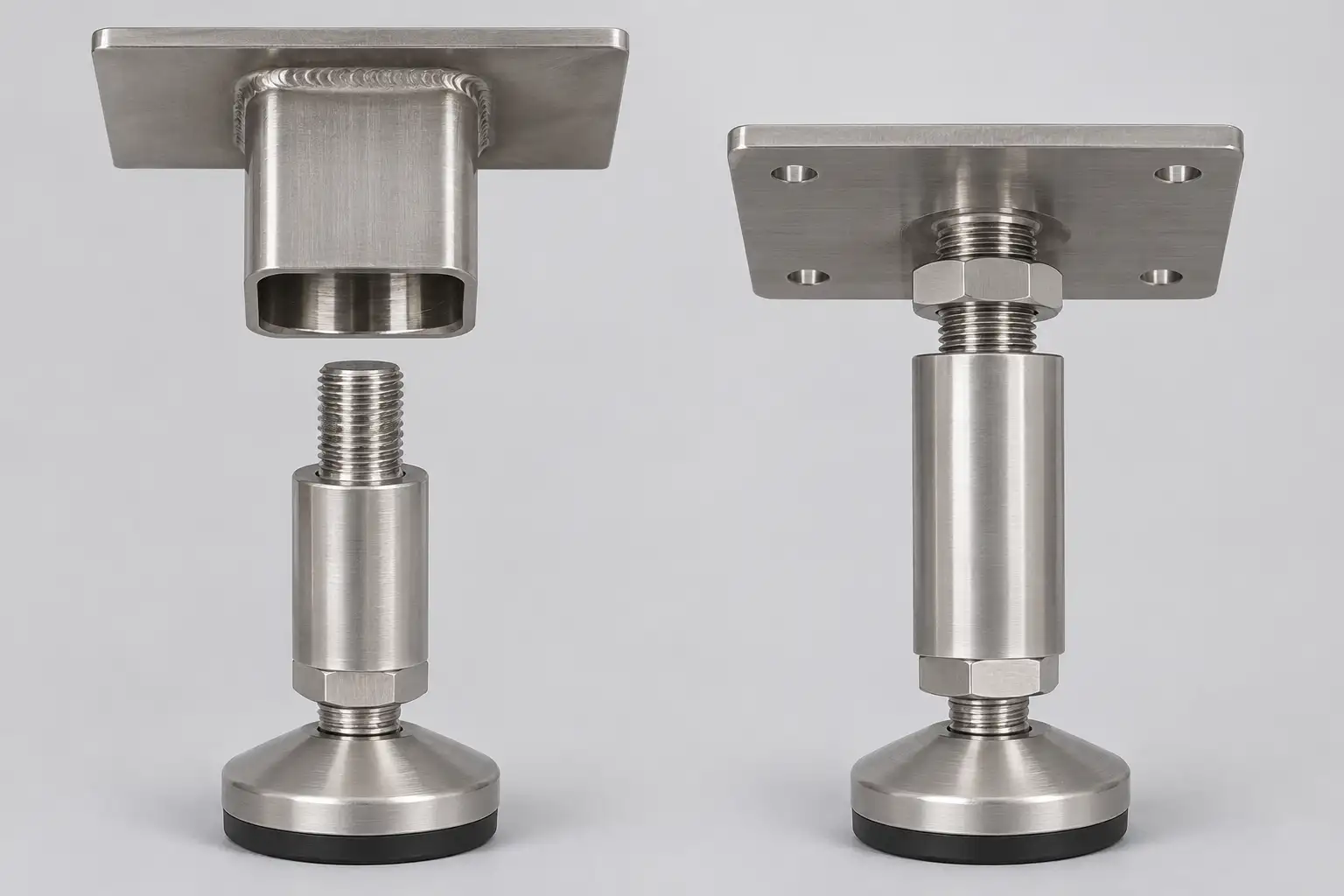
There is also an important overlap: a welded mounting plate or receiver can hold a threaded leveling foot. Before comparing prices, establish whether “weld-on” describes the frame connection, the adjustment mechanism, or an entire leg assembly. Otherwise, two quotations may describe compatible features as competing alternatives.
What are you actually comparing?
A threaded foot typically uses a stud or threaded insert to connect with a compatible receiver. Turning the adjustment changes the equipment height within its permitted range. A weld-on arrangement connects a plate, socket, or leg section to the frame through welding; a separate adjustable section may still provide leveling.
Commercial kitchen регулируемые ноги include different base shapes, materials, and configurations. Those differences matter alongside the mounting method. A short support beneath a preparation table and an extended leg beneath a loaded appliance should not be selected from appearance alone.
Ask for a sectional drawing showing the frame, receiver, adjustment thread, locking arrangement, and floor contact. Mark the permanent connection and the serviceable parts. This drawing often resolves the purchasing question faster than a description such as heavy duty.
Where does each arrangement make sense?
For an existing appliance with an intact threaded mounting point, a matching replacement foot is generally the first option to investigate. It can preserve the intended installation method and avoid fabrication work. Confirm compatibility with the equipment manufacturer before substituting a different design.
For a new stainless steel table or fabricated equipment frame, a welded receiver can make sense when the fabricator controls the joint design, materials, welding procedure, and finishing. It also allows the replaceable adjustment component to be specified separately from the permanent frame connection.
|
Decision factor |
Weld-on mounting arrangement |
Threaded mounting arrangement |
|
Initial installation |
Requires an approved welded connection |
Requires a compatible threaded receiver |
|
Replacement access |
Depends on which components remain removable |
Often allows removal of the threaded component |
|
Level adjustment |
May use a separate threaded section |
Usually provided by the adjustment thread |
|
Main design checks |
Joint, frame wall, alignment, finish |
Engagement, receiver strength, alignment, locking |
|
Best starting point |
New fabrication with controlled drawings |
Service replacement with verified compatibility |
Treat these as selection tendencies. A poorly designed threaded receiver can fail, and a poorly executed welded connection can fail. The attachment label provides no load rating.
Which option supports heavier equipment?
Use the allowable load for the complete installed assembly. A foot’s catalog rating does not establish the capacity of a thin equipment panel, welded nut, mounting plate, or finished frame. The weakest element in the load path can govern the result.
Static ratings also need context. For example, JW Winco’s GN 343.4 data describes testing under vertical static loading for a limited duration. Such a rating should not be treated as blanket approval for sideways pushing, uneven support, impact, or a different installation geometry.
Dividing total equipment weight by four is only an initial estimate for four supports. Floor unevenness, an off-center load, open doors, and stored contents can change the reaction at individual feet. Ask the equipment designer to establish the relevant load cases and margin.
The extension setting deserves attention. A support that looks satisfactory near its minimum height may behave differently when extended. Obtain the permitted adjustment range, minimum engagement, and installation instructions for the actual combination. Do not invent a universal number of exposed threads.
How do installation and service costs differ?
A weld-on part may have a modest purchase price while requiring additional fabrication, alignment, finishing, and inspection. Include those operations in the quote. Welding onto a finished appliance can also affect adjacent surfaces and components, so the equipment manufacturer should approve any modification.
A threaded replacement may reduce installation work when the receiver is sound and accessible. That advantage disappears if the thread is damaged, the insert turns inside the frame, or a different thread standard has been supplied. Never force a nearly matching stud into place.
Where the removable lower support is the service item, compare пулевые ноги by their actual interface and dimensions. A similar outer diameter does not confirm thread pitch, engagement, or suitability for the appliance.
Service access should appear on the drawing. Can a technician reach the wrench flats? Can the part be removed without dismantling a cabinet? Must the equipment be lifted, and what approved support method is required? These questions affect maintenance time more directly than a small difference in component price.
Which design is easier to keep clean?
Cleanability depends on the finished geometry. Exposed threads, gaps around inserts, unfinished joints, and inaccessible ledges can all complicate cleaning. A smooth-looking weld is not proof of a hygienic assembly, and a threaded design can be easier to maintain when its adjustment area is appropriately protected.
Specify the intended cleaning chemicals and exposure conditions before choosing materials. Stainless steel is not a single grade, and the base pad, insert, fasteners, and welded area may require separate review. Confirm compatibility with the cleaning method rather than accepting a general corrosion-resistant description.
During sample review, inspect the underside as carefully as the visible leg. Check for sharp edges, dirt-catching recesses, incomplete finishing, and places where cleaning fluid could remain. Ask how damaged pads or seals are replaced if those components are part of the design.
Avoid assuming either mounting method supplies sanitation certification. If a particular approval is required for the finished equipment, obtain documentation covering the relevant product and installation.
What should buyers put in the RFQ?
Start with the equipment drawing and the required installed height. Then identify adjustment travel, attachment dimensions, thread designation, frame material and thickness, floor contact requirements, and available installation space. Keep confirmed requirements separate from dimensions still awaiting engineering review.
State the equipment’s operating weight and how it is used. A stationary worktable, a refrigerator with frequently opened doors, and equipment moved during cleaning create different design questions. Feet are not substitutes for casters or approved movement arrangements.
Request a sample assembly instead of approving the foot alone. Check fit at the minimum and maximum permitted settings, access for adjustment, locking where specified, and stability on a representative floor. Record the approved configuration with photographs and a drawing revision.
For production orders, require inspection criteria tied to that revision. Thread fit, mounting alignment, surface finish, and critical dimensions should have agreed acceptance methods. Load verification needs an approved procedure and acceptance criteria; a salesperson’s description is insufficient.
Keep one approved sample with the purchasing and inspection records. Where several equipment models share similar feet, label the thread and mounting configuration clearly to prevent substitutions during assembly. Ask the supplier how drawing changes will be communicated and whether replacement components will remain identifiable after installation. On receipt, inspect parts against the approved revision before they reach the production line. This is particularly useful when an outer leg tube conceals the receiver: an apparently correct support can still contain an incompatible internal interface that becomes expensive to discover during final assembly.
A practical selection rule
Choose a threaded replacement when the existing equipment provides a compatible, undamaged interface and the approved part meets the service conditions. Choose a welded mounting arrangement when new fabrication benefits from a permanent receiver and the fabricator can control the connection. Use a combined welded-receiver and threaded-adjuster design when it meets both fabrication and maintenance needs.
Compare installed lifecycle cost: component purchase, fabrication, finishing, installation, inspection, replacement access, and expected spare-part availability. A repairable assembly can be valuable even when its initial unit price is higher. That conclusion still depends on verified compatibility and load suitability.
For a new project, send Simple the frame drawing, operating load information, height range, cleaning conditions, and expected quantity to discuss an adjustable-foot selection. Ask for a proposed configuration and the documentation needed for your equipment designer’s approval.
Часто задаваемые вопросы
Are weld-on adjustable feet always stronger?
No. Strength depends on the foot, receiver, connection, frame, and loading conditions. Compare verified ratings and installation requirements for the complete assembly.
Can a weld-on mount still have threaded adjustment?
Yes. A welded receiver can contain a removable threaded adjuster. Confirm which portion is permanent and which part can be replaced.
Can I replace a foot using only its diameter?
No. Check the attachment type, thread size and pitch where applicable, height range, engagement, base geometry, and equipment compatibility.
Should equipment be adjusted while fully loaded?
Follow the equipment manufacturer’s installation procedure. Arrange approved unloading, lifting, and support before service; never work beneath unsupported equipment.
Is a rubber base always preferable?
No. Review floor conditions, cleaning chemicals, temperature, load, and the pad’s documented properties. A rubber appearance alone establishes none of these.
