


5 дней в неделю с 8:30 до 17:30

How Should OEM Buyers Specify Layer Spacing for Multi-Layer Fryer Baskets?
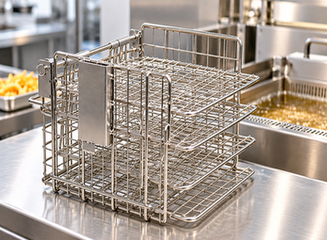
А multi-layer fryer basket can match the fryer’s dimensions and still be unsuitable for the food it needs to hold. The problems between the layers of a multi-layer fryer basket can be significant. If the space between the layers is too small, thick articles of chicken for example, will press against the articles in the layer above and could potentially stick to each other with their breaded surfaces. Also, when removing cooked food from the basket, there is a risk of damage. Space between the layers that is too large, on the other hand, results in an unsuitably high basket. OEM buyers must specify the space between the layers on the basis of the height of the food, possible expansion, useful clearance, access to the layers for loading, etc. The maximum weight that can be placed on each layer must also be taken into account. This must be settled before the drawing is approved, not after the first production article has been made.
How Should OEM Buyers Measure Food Height Before Setting Layer Spacing?
Start with the food, not the basket.
An OEM buyer ordering a multi-layer fryer basket for breaded chicken should know more than the average thickness of one piece. Actual portions vary. One chicken fillet may lie relatively flat, while another has a raised center or an uneven coating.
If the basket is designed to average size samples, then some thicker samples will touch the tray above.
Measure the Food as It Will Be Loaded
Use representative samples from the intended menu or production process. Measure their maximum height after preparation, including breading, batter, or other coatings.
There is an important distinction between an uncoated portion as it is raw and as it is ready for frying.
For mixed-size products, record the height range rather than giving the supplier a single nominal value.
A simple measurement sheet can include:
|
Food characteristic |
Information to record |
|---|---|
|
Food type |
Chicken fillet, wing, cutlet, etc. |
|
Typical thickness |
Height of representative portions |
|
Maximum loaded height |
Tallest expected portion, including coating |
|
Shape variation |
Flat, curved, irregular |
|
Loading orientation |
Flat placement or another specified arrangement |
|
Pieces per layer |
Planned loading pattern |
These figures set up the starting point for the basket drawing.
Avoid Designing Around the Smallest Portion
A practical example for a breaded chicken fillet basket could be: while most samples are approximately 20-25 mm in height, some samples could reach 30 mm in height, and thus need to be accounted for in the OEM specification, or limited to a particular portion size.
The finished basket may work with test samples but then cause problems in normal kitchen use.
How Much Expansion Allowance Should Each Fryer Basket Layer Have?
Food does not keep its original size when being fried.
Moisture loss, denaturation of proteins, expansion of batter and deformation all affect the shape of portions. However, the extent to which these factors affect shape depends on the ingredients used and the method of cooking. There is no single expansion factor that can be used for all fried products.
The allowance for OEM specifications should come from food trials using the actual food.
Separate Food Expansion from Handling Clearance
These are two different requirements.
Expansion allowance allows for the food to change in size during cooking. Handling clearance allows for movement of food to and from the upper tray without damaging the tray.
By combining all these plots into one ambiguous plot it is not clear why a sample failed.
For example, consider a purely illustrative design calculation:
Maximum prepared food height: 30 mm
Observed upward expansion allowance: 5 mm
Additional handling clearance: 8 mm
Preliminary required clear height: 43 mm
This is an example calculation and not an industry standard. You must confirm the actual size in food trials and with your operators.
Also please ask the supplier if he can deliver breaded, battered or rigid food articles in the basket.
A product that does not change shape during cooking will need a different cooling arrangement than a product whose coating expands greatly during cooking.
How Should Buyers Define the Actual Clear Layer Spacing?
One of the most obvious errors in multi-layer fryer basket RFQ’s is specifying ‘40 mm layer spacing’ without clearly stating where that dimension is measured from.
The supplier may misinterpret this to be the center to center distance of supporting wires, tray center lines or structural frames.
Those measurements are not interchangeable.
Measure the Usable Opening
For procurement purposes, layer height should be defined as the clear vertical space between layers, i.e. the space between the bottom of the lower tray’s food supporting surface and the top of the lowest obstacle above it.
That obstruction may be:
The underside of the next tray
A reinforcing wire
A crossbar
A welded bracket
Another structural member
Defining the pile height of a basket in this manner is more useful than simply dividing the total height of the basket by the number of layers.
Any projections from a reinforcing frame of a tray must be included in the usable clearance measurement.
Which Dimensions Belong on the Drawing?
For minimum information the OEM drawing should show the following:
|
Dimension |
Цель |
|---|---|
|
Overall basket height |
Confirms fryer compatibility |
|
Layer center-to-center pitch |
Defines structural tier positioning |
|
Clear vertical opening |
Confirms usable food space |
|
Tray wire/frame thickness |
Accounts for structural obstructions |
|
Usable tray width and depth |
Defines the available loading footprint |
|
Loading opening dimensions |
Confirms practical food access |
Use a section-view drawing whenever possible.
A side-view photograph can be useful but a drawing will still be required to show actual clearances.
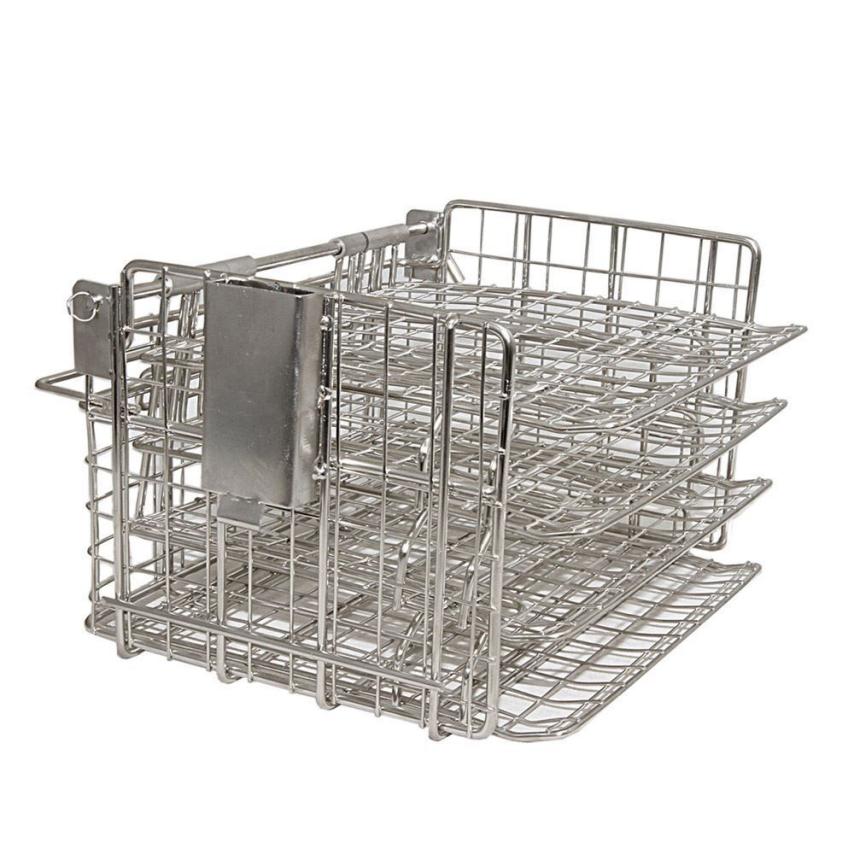
These measurements are particularly important for buyers of a four-layer stainless steel frying basket as the outer dimensions of the basket do not necessarily reflect the usable height at each level.
How Do Loading Access and Layer Weight Affect the Spacing Decision?
It looks okay loaded with food, but not very useful once it’s been loaded.
This lower tier storage area might accept a chicken fillet provided it is tilted. The nominal clearance into this entry may be sufficient, but the opening into the area is so small that loading and unloading of products is not easy.
Similarly problems can occur during unloading of the cooked food, when this has become fragile during transfer.
Check Loading and Unloading Separately
OEM buyers need to test how food is placed into the various levels of the unit and then removed after cooking by the intended operator.
Review aspects of cutlery access including hand access, grip position, opening of tray, food orientation and whether upper tiers of cutlery obstruct lower tiers of cutlery.
Testing must use appropriate handling tools and safe, cooled samples prior to the supervised cooking of samples.
Bending the basket, forcing food under a frame or scraping coating from the upper surface of the tray should not be required by the operator.
Don’t Ignore Uneven Layer Loads
A multi-layer frying basket must also be able to hold the intended food weight.
If one tier is loaded more heavily than another, its support wires and frame may deflect. Even modest deflection can reduce the usable clearance below the loaded tier.
The buyer should therefore specify:
Maximum intended food mass per layer
Intended total basket load
Permitted load distribution
Required structural support
Acceptable deflection under the agreed test load
Can the tier supports attach to the rest of the frame?
An apparently straight, flat basket will often tilt and deviate from a straight line when fully loaded with all layers.
What Should OEM Buyers Test Before Approving a Multi-Layer Fryer Basket Sample?
Sample approval should replicate the test conditions as closely as possible.
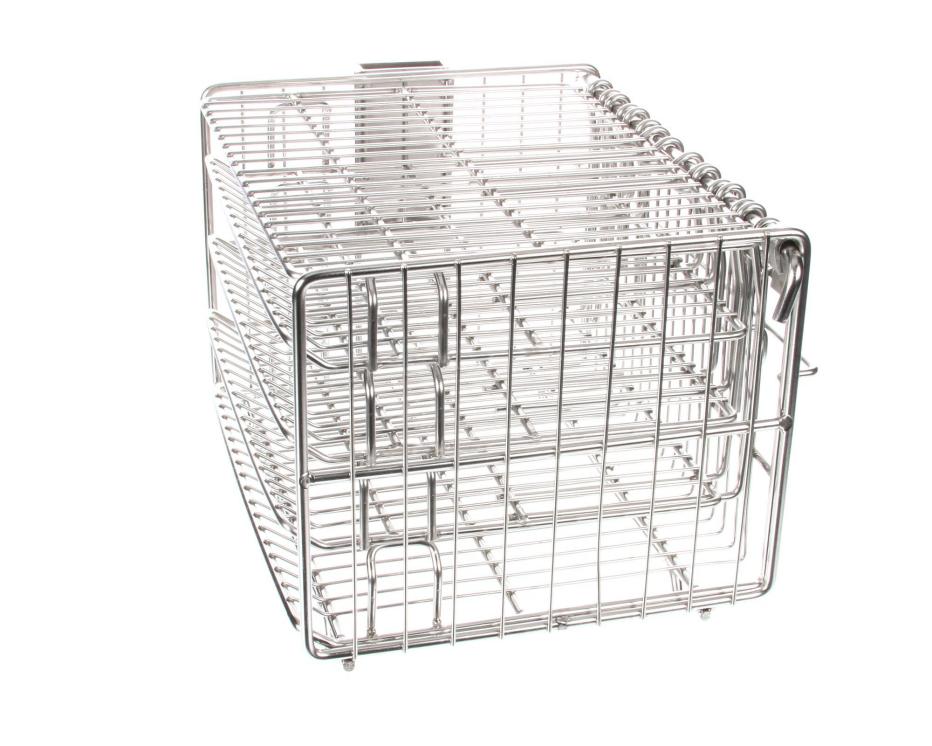
Start by conducting a dimensional inspection. Measure the actual clear opening over several areas, not just a corner. Look for any welded wires or reinforcement members that may protrude into the loading space.
Next, conduct a food-loading trial.
Representative portions of food should be used including thicker portions. Load the tiers one at a time in the orientation in which they are to be displayed and note whether the food comes into contact with any of the surrounding structural parts.
Next review the loading and unloading. The portions should be able to be handled by an operator familiar with the intended use of the kitchen, without being forced through the opening.
Lastly, verify load-related deformation and basket fit in the intended fryer.
OEM Sample Approval Checklist
Maximum prepared food height recorded
Expansion allowance supported by food trials
Clear layer spacing measured on the sample
Loading opening checked with actual food
Upper and lower tiers accessible
Maximum intended load per tier established
No unacceptable tray deflection under the agreed load
Overall basket dimensions match the fryer
Drawing and approved sample agree
Do not mistake a failed sample for the whole basket at wrong height, but try to establish the root cause first.
Sometimes a simple adjustment of the support wires or of the loading opening is sufficient to overcome a problem. On other occasions, it may be necessary to adjust the number of layers or the interface to the equipment.
For repeat OEM orders record the approved clearances and the acceptance criteria instead of relying on supplier’s reference sample.
Need Help Matching Multi-Layer Fryer Basket Specifications to Your Equipment?
For OEM buyers, the main problem is to translate food dimensions and a specific fryer into a sufficient drawing of a basket. The commercial kitchen accessories supplier Foshan Simple Technology Co., Ltd. offers a wide range of different models of multi-layer fryer baskets for industrial frying equipment. By comparing the dimensions, the material and the construction of the baskets offered by this supplier, the buyer can find the suitable model for his applications. For specific layer distances the discussion about the purchasing of such a basket must also contain the food height, the necessary clearances, the loading openings, the support of the single tiers as well as the compatibility with the frying equipment. Before the production in large quantities a drawing and a physical sample are the best proof for the required characteristics of a basket, which has to be integrated into already existing equipment.
Вывод
There are several important factors that influence the layer spacing in multi-layer fryer baskets, and it is not only a matter of the number of tiers. The maximum height of the food to be cooked, the extent to which it will expand during cooking, the clear vertical opening, the loading of the basket, and the loading of individual tiers all need to be considered separately. All these requirements should be put on a dimensioned drawing and be tested with sample food and realistic loads. Only after the actual clearance and handling of the sample have been approved, the approved dimensions should be used for the production control.
Часто задаваемые вопросы
1. What is the ideal layer spacing for a multi-layer fryer basket?
There is no universal dimension. The required spacing will depend on the maximum prepared food height, the change in height of food during frying, the required handling clearance and any structural features projecting into the opening and requiring clearance.
2. How should clear layer spacing be measured?
For the lower tray measure the usable vertical space from the top of the tray’s supporting surface to the closest obstruction above it. This includes any reinforcing wires, brackets, etc. that take away from food space.
3. Should OEM buyers allow extra space for breaded chicken?
This can occur during cooking and Trials should demonstrate this effect. A single breaded portion should be used for assessment of representative products and an Allowance established from the results of such Tests rather than applied blind.
4. Can heavy food loads reduce the clearance between layers?
Yes. The usable clearance of a tray can decrease if the tray or its supports deflect under load. Verify the supplier’s data with respect to the intended load per tier and the structural behavior of the complete basket.
5. What should buyers provide when ordering custom multi-layer fryer baskets?
Please provide dimensions of your fryer, height of food, clear space needed between tiers, opening dimensions for loading, intended load per tier, required materials and a drawing. We can test a sample configuration before we start production.
